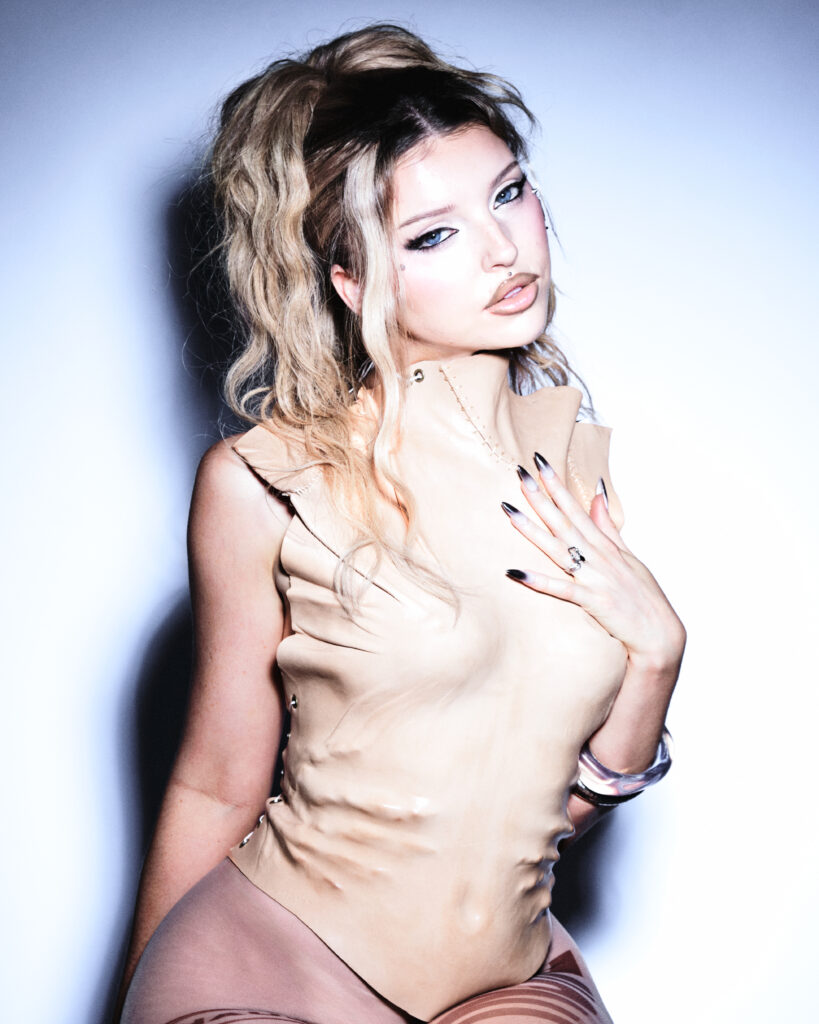
For a while, Larissa Lambert used music as a form of emotional survival, turning to her craft mainly when heartbreak or heavy trauma demanded to be processed. But sitting down with her a month before the arrival of Yearning–her long-awaited debut album–reveals an artist who has finally stepped out from under the weight of “the saddies” and into a place of peace.
Yearning represents a defining evolution for Lambert. Moving past the belief that music must bleed to be meaningful, she has crafted a deeply cohesive body of work anchored in late ’90s and early 2000s R&B nostalgia, guided alongside longtime collaborator Khaled Rohaim. Sonically and visually, the album creates a world all its own, one that blends dark fantasy, warm summer nights, eerie ocean cliffs, and an unapologetic celebration of love in all its forms, from toxic attachments to fearless devotion.
In our conversation below, Lambert opens up about shedding outside noise, performing her most authentic songs yet, and finding the beauty and safety in writing love songs.
Alana Ash (Cult Machine): How long has this album process been for you?
Larissa Lambert: Most of the songs I wrote last year and the year before, but some of them have been sitting in the vault for like six years.
Like, my entire career.. I’ve never had an album. The debut album is like the moment, you know?
AA: Yes, so now those songs finally have a home after all of those years! What do you hear in this album that you couldn’t hear before in your earlier work?
LL: I think just more clarity. Clarity of who I am as an artist and my direction and sound. I think a lot of my stuff in the past, I was listening to the outer noise and what I think people want to hear from me rather than doing what I genuinely want to do, and it really shows in the album because it’s very cohesive.
AA: You spent a lot of your career turning very intense feelings into music. Do you think happiness has been a bit harder for you to write about than heartbreak?
LL: Yeah, I think so, but I also think I’m at a place in my life right now where I’m at peace and happy and content, so it’s really reflecting in the music. Whereas in the past, I would use music more as therapy. So whenever I would feel something really deep and emotional, I can turn it into a song because it was so easy. But I would sit down and try to write a happy song, I’m like, “no, it sucks.” But really, sometimes we need that. We need the love songs!
AA: That’s true, that’s true. We need the sprinkle of happiness in life.
Your early music often feels like you were documenting what was happening to you in real time, and on this album there seems to be more distance between experiencing something and deciding what it means to you. Has that kind of perspective or that distance changed the way you write?
LL: No, I think I still write whatever I’m going through. It definitely has to relate, otherwise I won’t connect with it and it won’t feel authentic. Some of the songs that I wrote six years ago that I’ve made on the album have had surgery to make them connect more to who I am now versus who I was six years ago.
I feel like it’s really important for me to actually live through what I write about. But I’ve definitely written songs in the past where I feel like I was just writing a song, and I kind of dread singing them sometimes. I love them, but I don’t have that connection like I do with this album.
AA: For this album, what song are you most excited to sing live?
LL: Oh my gosh, all of them. Oh, there’s so many–I’m just so happy with it. That’s another thing, that I really can sing these songs comfortably as well because they’re just very authentic.
Do It To Me is a favorite of mine that I’m excited to sing.
AA: As you said, you’re now at a place in your life where you’re more at peace. Was there a particular song where you first realized you were writing from this new place?
LL: Maybe I Love You Out Loud.
I think that song was really the switch, the one that I feel like I Love You Out Loud is the essence of the album overall. I feel like when I think of Yearning, you think it would be my song Yearning because my album is called Yearning, but I Love You Out Loud is yearning to me.
There’s something noticeably different about the way Larissa talks about love on Yearning. “I Love You Out Loud” carries a much more uncomplicated kind of feeling than some of the album’s heavier moments, but for Larissa, writing about love openly wasn’t necessarily the difficult part. It was simply something she hadn’t felt ready to write about before.
In the past, she says, she was more occupied with processing the trauma and darkness in her life. “I need to get that out of my system,” she recalls thinking. Now, after working through much of that, she finds herself in a different place. “The saddies are out,” she laughs. “I’m at peace. I need to just manifest positive energy and love and all that.”
That shift became one of the quieter revelations of making Yearning. Larissa says the album helped her stop listening so closely to the outside noise and, more importantly, to her own old idea that music had to hurt deeply to be meaningful.
“You don’t need to be an emotional wreck to connect with a song,” she says. “You can connect with a song that is just a good-feeling love song.”
It’s a small realization, but one that seems to have changed the way she understands her own music. For a long time, if a song didn’t leave her with some deep emotional ache, she assumed it wasn’t special enough. Yearning seems to have taught her that maybe peace can be just as meaningful.
AA: You’ve worked with Khaled Rohaim across different stages of your career, and now that collaboration has become part of the Yearning sound as well. Is there anything that he can hear in your songs that might be too close to yourself to hear? Maybe that he helped you discover about yourself or pushed you?
LL: Our brains musically are so similar that it’s freaky. We know each other so well now. We’re so tapped in. We have the same ear for things.
Khaled was so important in this album because he helped it become cohesive, to make it all sound in the same world. Because I think you can make amazing songs, but for an album, I feel like it’s important to make it all follow the story, like all live in that world.
AA: When making this album, did you imagine its own world instead of just making each song stand out as its own?
LL: Yeah, yeah. I originally was just writing the songs from where I was mentally, so they’re all going to be cohesive regardless of where I was coming from in these sessions. The world came after.
I think I had to sit back and evaluate, like, okay, what songs have I got, and then how am I going to make this a story or make this make sense to me in a deeper way than just being a bunch of great songs?
AA: When you think of this album, when you’re listening to it, what visual world comes to your mind?
LL: So I’m really into, like, dark fantasy, Nightcore, but I specifically have this visual of, like, the weather is like a summer night, so it’s really warm. You know the summer nights that are just really warm?
AA: Yes.
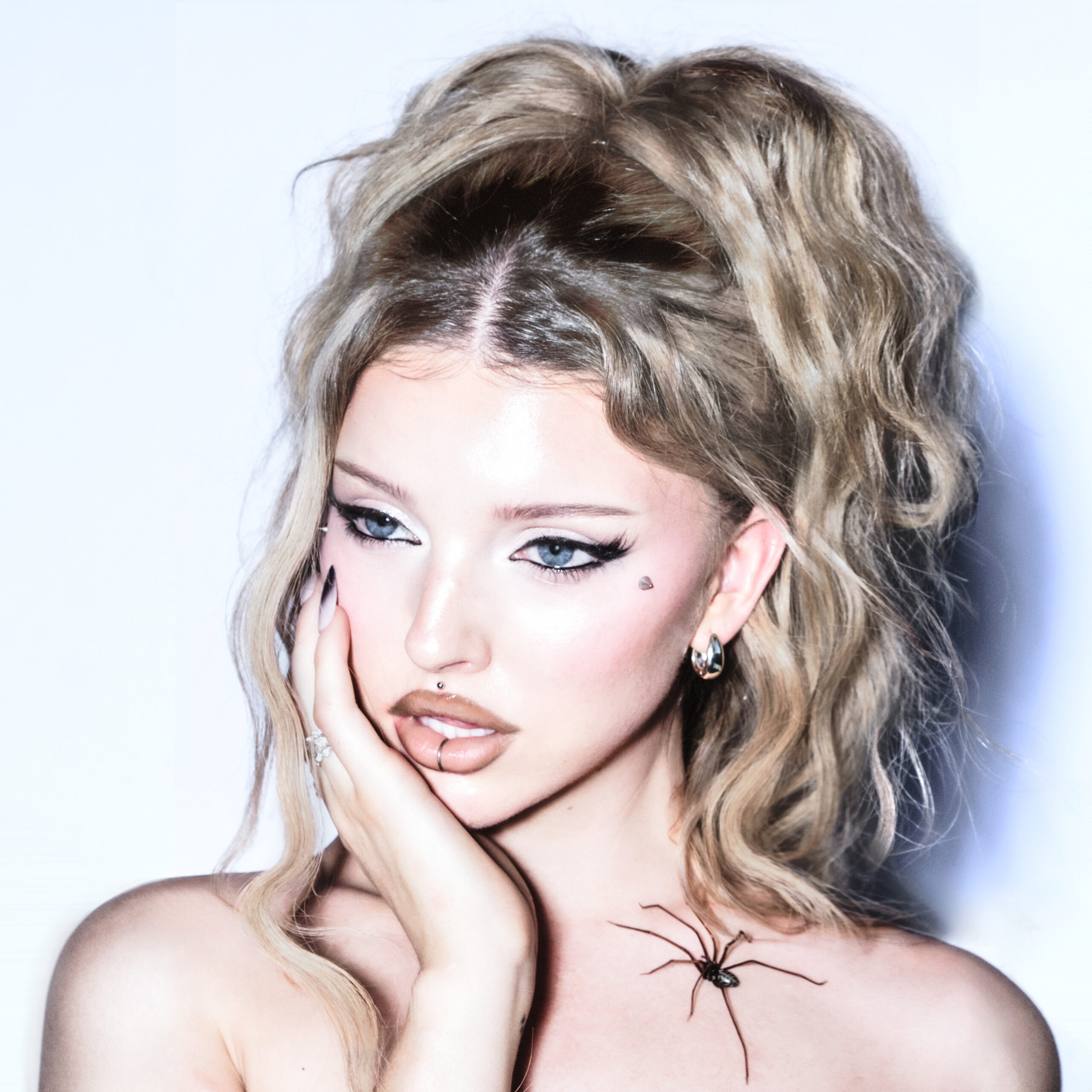
LL: Dark, but I picture almost like a Scottish mountain with a bunch of wildflowers and a cliff, like an ocean. So it has this sense of eeriness but also comfortability, and that’s what I’m trying to portray through the visuals and through my album art. You know, you’ve got my face with the spiders. It’s always like a sense of, like, this is intriguing, you know what I mean?
AA: Do you think you’re naturally drawn to beauty that has something unsettling underneath it?
LL: A thousand percent. I love it. I love anything fantasy, though. I love sirens and dark fey and things like that.
AA: Do you think there’s a difference between wanting a person and wanting the version of yourself that exists when that person wants you?
LL: I guess for me personally, you just gotta be as authentic as you can at the start. But I feel like in this day and age, a lot of people feel like they have to portray themselves to be someone they’re not.
Especially with social media, you get to think about who you get to be when you’re courting someone. They get to think about their replies. Whereas I’m always… I’m an in-person person. What you see is what you get when it comes to personality and who I am at my core. So I think that’s the way to be.
AA: While writing the album, what do you do to stop the burnouts?
LL: Nature, for sure. I go camping a lot, so that’s my way to turn my brain off.
I love just being out there with a tent and no phone, no service, and just tapping into the inner child. Things that you do as a kid, like looking for little bugs in the river, just playing with dirt, as simple as that.
AA: Was the emotional movement in the entire album, something you consciously built into the sequencing, or did you only recognize it after the entire album was finished?
LL: Yeah, I definitely was. Each session last year when I was writing it, and the year before, I was going in saying, “I’m in my lover girl era!” I want to write love music, basically.
But there’s definitely still some sad songs on there, but they still allude to love in a sense, whether it’s self-love or toxic love. So all in all, it kind of still ties into Yearning.
AA: It’s a lot, but it’s all about–
LL: Love.
AA: It’s all about love!
LL: Exactly. Love.
AA: Putting this out into the world, do you think putting something this intimate into a song ever makes you feel more exposed than saying it to one person?
LL: No, not at all. If anything, I feel more exposed when I write the toxic stuff. Because that’s diving into your mental state and how you’re avoiding attachment to insecurities, putting your business into the world. I feel more safe doing love songs.
AA: Okay, if Yearning, kind of a fun question, if Yearning had a film, or if it was a film, what kind of film or genre would it be?
LL: It’s gonna be something like The Notebook, surely, or like Dracula, like a love tale that has dark fantasy.
AA: What would be the closing track? Or would the album closer be the closing track?
LL: Yeah, I think so. I kind of envision that as the ending credits.
AA: If Yearning had a signature drink, what would be in it?
LL: I’m only gonna say this because it’s my favorite, but an iced strawberry matcha.
But if I’m going off visually, maybe like a… I don’t know, what’s yummy but eerie? Something dark, yeah, like whiskey or something.
Now, Yearning is finally out in the world!
In the record, Larissa Lambert gives it something deeply human–a place for us to sit with our feelings, romanticize our lives a little, and unabashedly feel love in every shade.
It’s the kind of record that deserves to be lived with and easily! a must-listen for this year’s R&B releases. There’s room on Yearning for the broken hearts and the lovers, for the parts of ourselves we are still trying to understand and the parts we’ve finally learned to accept. More than anything, it feels like an album made by someone who no longer needs to be hurting to prove that she feels deeply. Just like the feeling itself, Yearning lingers yet it doesn’t ask us to choose between the darkness and the light. It lets us exist somewhere in between, with our hearts still open.
Listen to Yearning now on all major platforms.