Women have been making space for each other in music for decades. From Lilith Fair to the Riot Grrrl movement, these communities have always found ways to turn music into something bigger than a stage – a place to connect, speak up, and simply feel like you belong. Today, that spirit is still very much alive, from the growing success of festivals like Olivia Rodrigo’s Daisy Chain Fields to a new generation of women building their own spaces from the ground up.
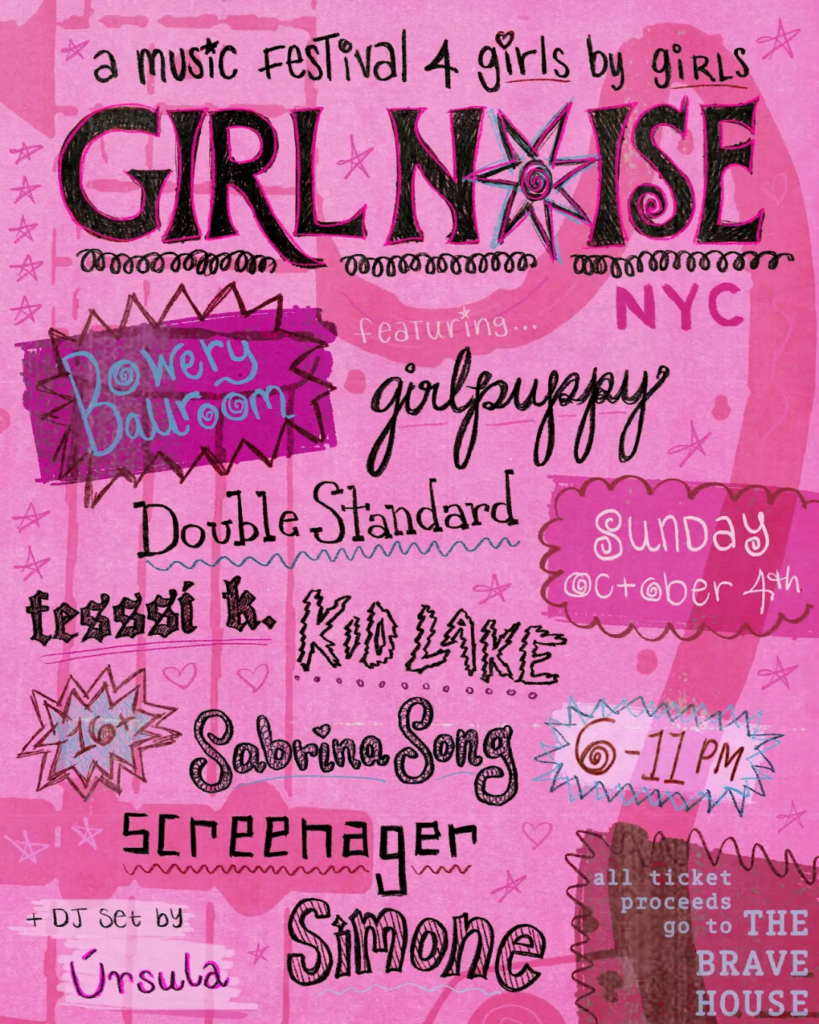
One of those spaces is Girl Noise, founded by Simone Lipkin in 2025 as a celebration of women’s voices across music, art, and advocacy. Inspired by the legacy of Lilith Fair and Riot Grrrl, Girl Noise brings women artists, creatives, and activists together through community-driven shows, while putting its values into practice offstage, too. Every show supports a women-led nonprofit, with its upcoming October 4 event at New York’s Bowery Ballroom benefiting The Brave House, which supports young immigrant women and gender-expansive youth.
The upcoming show will be Girl Noise’s third (and its biggest yet!) featuring headliner girlpuppy alongside six other emerging female artists. We spoke to Simone about building community, taking up space, the power of fangirls, and why music and activism have always belonged together.
ALEXA (Cult Machine):
Women have been creating their own spaces in music for decades, from Lilith Fair to Riot Grrrl. Even with all that time passing, what do you think makes this feel so relevant today, especially for women our age? Why do you think we’re seeing people create these spaces again?
SIMONE:
I think it’s really interesting to think about why it ever stopped. I don’t think it should have. These are important things that we should consistently be doing to uplift women.
A lot of times, I think we feel like we need to come together only when there’s a crisis happening, or when something feels urgent. Something I wanted to do with Girl Noise was really make something that felt everlasting—no matter what time or place.
A lot of people feel that same need and longing for community, which was one of the catalysts for starting Girl Noise. Especially in these times, things feel very chaotic, disorienting, and isolating. I think younger generations want to be around people who feel the same things they do, especially in person. It’s something that, as a culture, we’re really longing for. That’s why I think we’re seeing so much of it right now. That need is definitely coming back.
ALEXA:
What do you think makes it so hard for women currently to get into the scene on their own, whether that’s as an artist or working behind the scenes in music?
SIMONE:
I think sometimes it’s hard to be taken seriously. That’s something that has never really gone away, and it’s something that I still struggle with a lot.
There are a lot of times where you’ll be in a room and you’ll be the only woman, and it just feels like, whether it’s subconscious or not, there’s a kind of belittling or diminishing of certain ideas that you may have. There’s also this idea that we always have to be taught things, that we always have to say yes to everything, be polite, and be on the receiving end of a lot of bad behavior.
From my experience, that’s been one of the biggest struggles and biggest things I’ve noticed: that lack of being taken seriously and being seen as an equal in a lot of spaces. I think that’s something we’re still fighting for, especially behind the scenes.
ALEXA:
You mentioned that you’re an artist. Was that what made you pursue Girl Noise? Was it what you were experiencing in the industry that gave you the fire to create somewhere where people could join without feeling like they constantly had to prove themselves?
SIMONE:
Yeah, that was definitely a huge catalyst.
I’ve been doing music since I was really young. I’ve been playing live since I was around 11, so I’ve just been doing this for a long time. It’s always been a passion of mine. It took me a while to gain confidence and perspective on a lot of things. As I grew up, I realized a lot about how the world worked, how systems of oppression worked, and how we’re all kind of a part of it.
These things just exist whether we like it or not. We’re born into these structures. I got to a point where I was very eager to take things into my own hands. I started putting my foot down and stopped working with certain people who I felt had treated me a certain way or thought of me a certain way. I became really intentional about the people I surrounded myself with.
That was directly connected to coming up with Girl Noise. It was like, “I want to be around women. I want to work with women. I want to be in spaces where I feel like I can fully express myself without fear of being belittled, not taken seriously, or diminished in any way.”
I think that was something I was really craving, and it all became very interconnected.
ALEXA:
It’s about making a safe space for people. Even statistically, the number of women working as artists, especially behind the scenes, is so low.
I think there’s something about walking into a room and seeing another girl your age or another woman and knowing you can look out for each other. You’re just in a room and you see other people who are like you.
SIMONE:
No, I understand. I felt it completely. I totally get it. I think sometimes I get asked what advice I would give to other women wanting to be in music, and I always just say: find other women. Find a community.
Networking is the biggest thing, honestly.
It’s easy to do, and it’s like girls who immediately understand where you’re coming from and also want the same thing. They want to be around people who uplift each other and believe in each other. That has been such a game-changer. Even in my life outside of my career, being surrounded by women and my female friendships has been so important to me and has really shaped who I am.
There’s just an understanding and a respect that we have for each other that’s really beautiful. I’m always longing for that and just love it so much.
ALEXA:
It can almost be seen as a rebellious act. You have Girl Noise, and even the name is about taking up space, which is kind of silly because you’re just trying to pursue the careers you want.
How do you feel about the power that comes from that? Do you think knowing that you don’t hear this as often makes you more committed to building your community?
SIMONE:
Yeah. You definitely feel the energy in the rooms, too, and how different it feels. Even just being in the green room and it’s a bunch of girls—there’s a mutual camaraderie.
Especially with this event, knowing that everyone who’s a part of it really believes in the mission and wants to be a part of the mission adds this really beautiful element. Everyone has that extra respect for one another and wants to build community. The idea of a bunch of women on stage or in the crowd expressing themselves so freely is kind of rebellious. It has always been rebellious.
Luckily, we’ve come such a long way in being able to express ourselves, but I think there are still a lot of people who feel uncomfortable about the idea of that. A lot of people still try to silence us in many ways. Coming together in that way and being in a room where everyone is so free, safe, and just in it together is so rare nowadays. It gives me so much hope. It feels very reassuring and really special.
ALEXA:
We throw around the word “empowerment” a lot—women’s empowerment and all of that. What specific things do you do through Girl Noise that make you feel empowered to keep going? Even little things that make you think, “Yeah, I need to keep putting women on stage because this is happening.”
SIMONE:
There are so many little things.
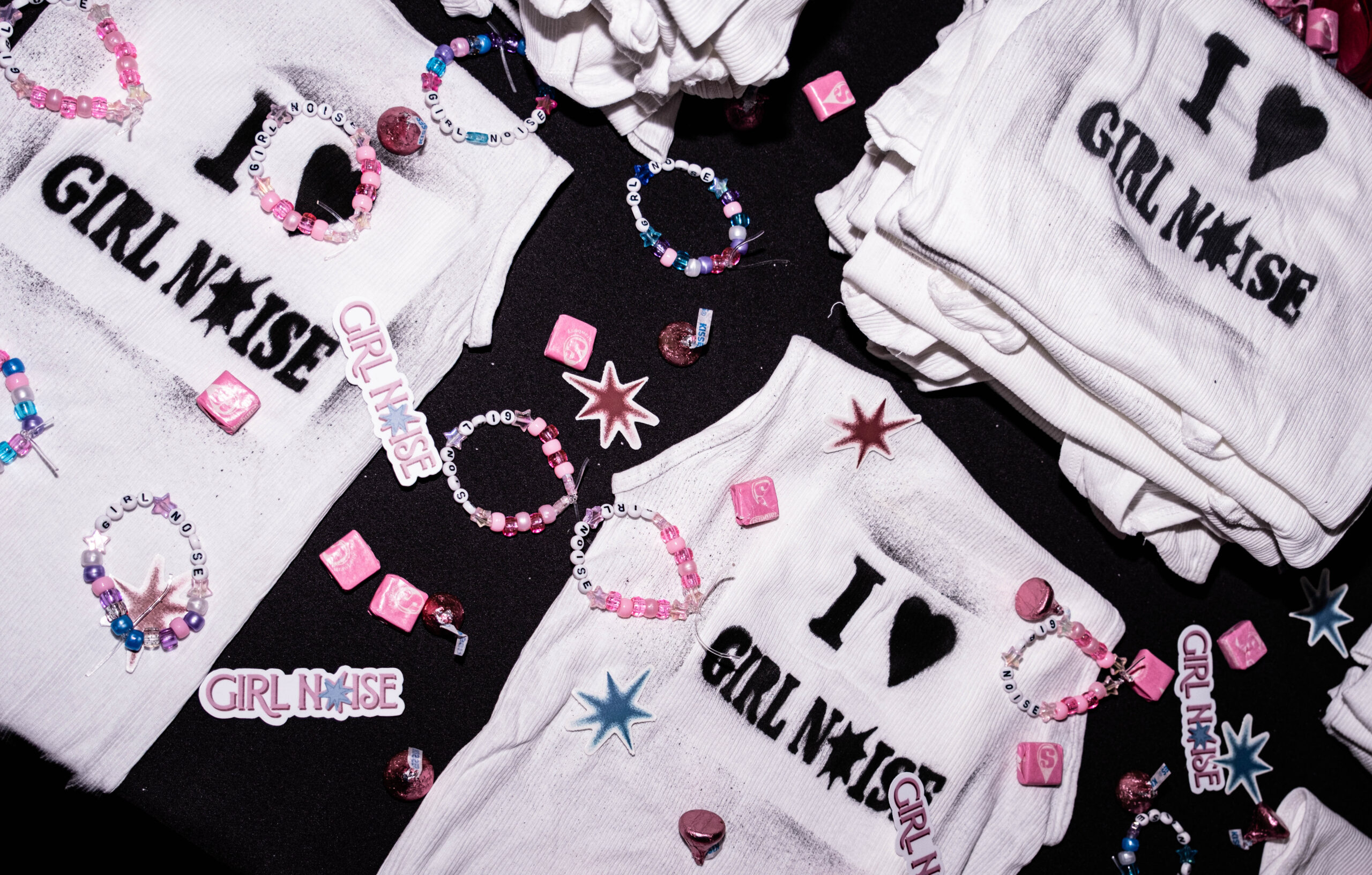
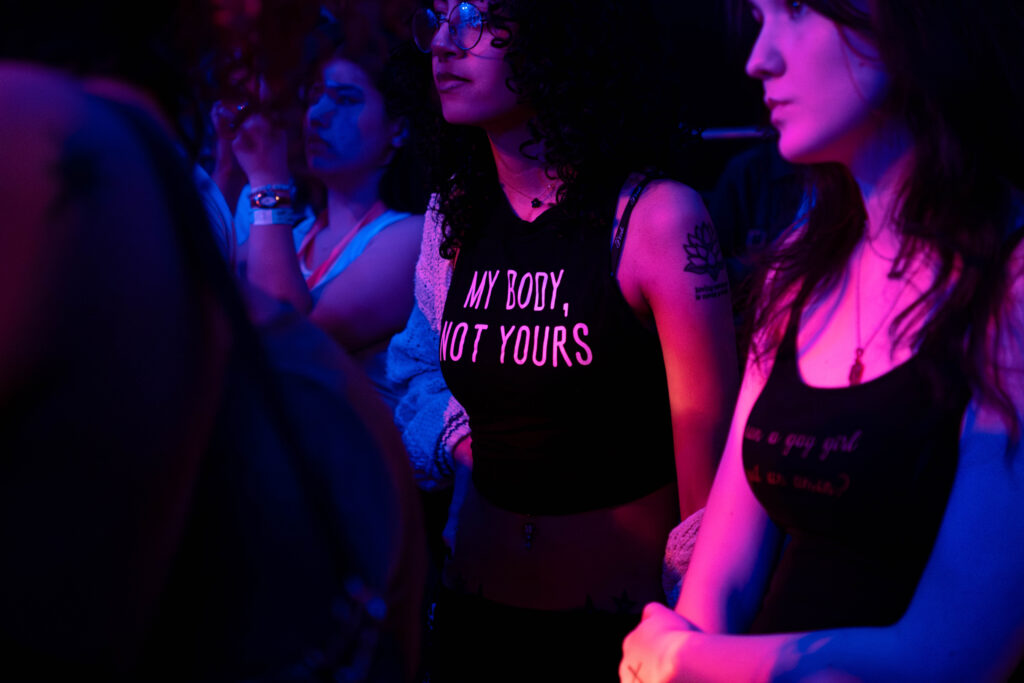
Obviously, just seeing women play music is my favorite thing in the world. Every time I put on these shows and get to watch these incredible women, I’m just like, “Oh my God, I want to listen to them all the time.” It’s the best. All the girls I meet at the shows are so fun to talk to. Seeing people putting on friendship bracelets, giving each other temporary tattoos, wearing the tank tops—it makes me feel very hopeful.
It feels very nostalgic, almost, and really unique.
The response from the shows has also been so encouraging and empowering. Even the girls who reach out to us because they want to help behind the scenes or cheer us on—there’s such an outpouring of people wanting to be a part of it. That’s really special to me because I think it shows how much people crave experiences like this.
I definitely want to continue having girls be a part of it and encouraging and empowering women behind the scenes, whether that’s having people work with us or volunteer who want to be a part of it and are passionate about it. That makes me so happy. That’s definitely a huge part of it, too.
ALEXA:
I agree with you. We don’t give enough credit to fangirls in music in general.
Even with The Beatles—the biggest band ever—at the heart of it were millions of women buying posters, physical media, showing up, and supporting them. You don’t realize how much you need women in this environment. Even calling them “fangirls” can lower their status when they’re the people continuously supporting music, buying things, showing up to shows, and keeping the cycle going.
You see a bunch of girls in the merch line. You see them showing up to your shows. They’re the reason it keeps going. I think that’s a really big community that doesn’t get enough credit.
SIMONE:
So true. I think about that all the time.
The biggest boy bands in the world are big because of the girls who showed up to the shows. One Direction would be nothing without the girls who showed up to the shows. The Beatles are the perfect original example of that. Women are so passionate and committed, and it’s beautiful.
I always say that a concert with a crowd of men is probably my nightmare scenario. I just think the artist is doing something wrong if they don’t have women in their crowd. Women are so passionate. There’s nothing like the experience of being in a crowd of women, even from an audience perspective. It’s the most beautiful thing to see all these girls wanting to be a part of something and being so passionate about it.
I think there was even a book written about how impactful these girls are. They have all the power, and I don’t think people give them enough credit for that.
ALEXA:
A couple of my friends recently went to Daisy Chain Festival, and I was seeing all their videos and pictures. I was like, “Why is it so pretty?” People were saying how safe and welcoming it felt.
It’s kind of insane how having more women in your community can create that sense of calm and safety. Not to say anything negative about men, but spaces aren’t always 50/50. When you don’t understand the oppression someone faces, you’re not always going to be as aware of it. As another girl, you’re always kind of on alert—thinking about how the people around you are doing—because you’re often in that position where you’re slightly uncomfortable or have to stand up for yourself.
SIMONE:
Yeah, no, 100%.
ALEXA:
Your organization is already inspiring more women. Who are some female artists who inspired you in your music, or even directors, producers, or people behind the scenes—anyone who gave you that push?
SIMONE:
So many women.
I realized this year that every month I have a hyperfixation on a woman. I’ll just be like, “Yeah, I have to read everything about them,” and learn about their career. Earlier this year, I got really into Amy Poehler.
I just love women who have really been trailblazers. She’s such a trailblazer in the comedy scene for women, and that was such a hard career to be in as a woman. It still is. It’s probably one of the hardest fields to be taken seriously in. I’m always inspired by women who are trailblazers in the sense that they push to be authentic and push to be respected for their authenticity. They don’t change or alter who they are to please people.
There are so many women like that. Obviously, Kathleen Hanna, who was kind of a pioneer of the Riot Grrrl movement, is such an inspiration to me. I was really inspired by all of that when I was thinking about Girl Noise. I did a lot of research on what that experience was like, what those people did, and why it was so important.
Then, obviously, Sarah McLachlan, who started Lilith Fair. There are just so many women over the years who have moved me in a certain sense. Even my mom. Any women in my life—I’m always inspired by fearless and brave women who are themselves, who use their voice, and talk about what matters.
The list goes on and on.
ALEXA:
Girl Noise gives people a literal stage through your events. How would you say your platform gives women a voice or another type of stage?
SIMONE:
A big goal with Girl Noise was to be able to uplift women on and off the stage.
We’re still just a year in, but my goal with every show is to spotlight women in all different fields and organizations. Every show, we support a women-led nonprofit. We have women-owned clothing vendors at every show, and we have women photographers and graphic designers.
This time around, I’ve also been going to small, women-owned businesses around the city and interviewing them, sharing them on our platform so people can learn about them and hopefully visit their stores. Any way that we can support women in our community, I’m always looking to do that. We’ve collaborated with a lot of different women-led organizations and have seen a lot of support there.
It feels really important to do that in every sense. I hope even people who aren’t in New York and can’t come to the shows feel that encouragement and inspiration to do that in their own communities. I definitely want it to feel like a bigger thing than just the events. I want it to be a real community that people feel a part of, no matter where they are.
ALEXA:
How important do you think it is to hire female photographers, promoters, designers, and writers in general for your platform and the events you’re hosting?
SIMONE:
More important than I can even express. Sometimes it’s made to sound like it’s a favor, and it’s like—no. You’re going to get the best product if you work with women. They’re so creative.
I think so often we’re built to feel like we have to prove ourselves, and that makes us work twice as hard. Oftentimes, you’ll find that it’s the women around you who really follow through.
Even this time around, this is my first time working with interns and different girls in the city—college students or people outside of college—and they’re so creative and passionate. It’s really awesome to watch. They’re all aspiring to work in different industries and with different photographers and graphic designers. They’re all just so creative, and it’s been such a fun experience to work with them.
I wouldn’t have it any other way.
It wasn’t even a question. I often just find that the people I want to work with happen to be women because I’m a fan of their work. It’s really important, and I couldn’t recommend it more. I especially encourage male artists to have women on their teams. I think it’s really valuable to have different perspectives. Especially with what we were saying about fangirls—they really know their way around it. They just get it.
ALEXA:
It’s such a testament that, in such a short time, you’ve been able to be in this position where you’re now giving other girls opportunities that maybe wouldn’t have come to light without you. All of these little things trickle down. Anyone could do it if they have the motivation, but the fact that you’re doing it and being brave about it is really powerful.
It’s crazy how, as a whole, you’re able to make an impact on people’s lives. I’m also speaking from personal experience. I just started getting into this, and I’ve met so many other girls my age who are also just getting into it. It’s comforting because sometimes you go into interviews and think, “Is my makeup too much? Is my hair too crazy? Am I sounding professional enough?”
It’s nice to know there are other people in your position navigating the same things.
Sometimes it does feel like a favor—like you have to work extra hard, or you’re only here because someone needed to hire a woman. But it’s like, no. You’re here because you’re supposed to be here.
SIMONE:
100%. Yeah. You’re here because you deserve it.
ALEXA:
What has been the most challenging aspect of starting Girl Noise?
SIMONE:
It’s truly a lot of work.
There’s just a lot that goes into it. Two things that are hard when it comes to work are that I’m a perfectionist and a control freak.
I’m very much involved in every aspect of the show. I’ve had to have conversations with my therapist about how I can tone it down a little bit because I really just want to do the best I can. I want to make sure that everyone involved in the show gets the most out of it—the artists and the audience. I try my hardest to make sure that it feels like it was worth the experience, whether you’re performing or going to the show. There’s a lot of work that goes into it. There’s a lot of less creative stuff that isn’t as fun but is just as important.
I think that’s definitely been a lesson. I’ve learned so much this past year about business and behind-the-scenes things that I probably never would have had to do or learn about if it weren’t for the show. At the same time, it’s been incredibly helpful and enlightening in my own personal life and career. I’ve gained confidence and gained a voice. I’ve learned how to speak up for myself, ask questions, and do all those things that sometimes feel hard to do.
I’ve been able to learn more about using my voice.
Overall, it’s been very informative and such a learning experience. If I wasn’t passionate about it, I don’t think I would do it because it really is a lot of work. But I love it so much and feel like it’s important to do.
ALEXA:
What’s the biggest piece of advice you’d have for someone, or something you wish you knew before going into all of this?
SIMONE:
There are probably so many.
Honestly, I do think knowing that it’s a lot of work is important. Any kind of endeavor involving something you’re passionate about—if you’re doing it on your own or fully committing to it—eventually you’re going to have to do things you don’t want to do to get to where you want to be.
If you don’t really love it or feel passionate about it, it’s very easy to give up or realize that it’s too much work.
In any endeavor, you need to know how passionate you are about it and really ask yourself, “Is this something I want to commit to?” I’m not someone who half-asses anything. I definitely full-send it. If you’re prepared to do that, then go for it. And know that it’s so worth it. Every show, I feel so much relief. It’s the same thing as writing a song. Sometimes it’s so much work, and then you finish it and you’re like, “Wow, that was so easy and fun. Let me do it again.”
You forget how hard it was because the product is always so worth it. It feels so fulfilling. Make sure you love it, and make sure you know what you’re getting yourself into.
ALEXA:
You guys are having your biggest show this October 4th at the Bowery Ballroom. What makes this one feel so different from the previous ones? What do you think got you here to finally be able to throw this level of a show?
SIMONE:
My goal going into it was to hopefully get a little bigger every show, and I think we succeeded in that, which was great. Our last show sold out, which was really exciting and gave me the encouragement to feel like we could do a bigger venue.
This venue is almost double the size of our last venue, and it was definitely a commitment. I knew going into it that meant double the work, double the cost, and everything is double. But I love that venue so much. When I was thinking about upgrading venues, this was the only one I had on my mind. It had to be the perfect spot.
The fact that it’s happening is so exciting. I couldn’t be happier about the lineup.
It just feels like an upgrade in general, as far as the response and everything. I feel like I know more this time around. Obviously, every time I learn more about how to do this, but I’m kind of dealing with it all a little bit better or just knowing how to deal with it more. Every show feels like a bigger deal, but in a good way—in the best way.
ALEXA:
How do you pick all your artists? What connects them when you’re creating the lineup?
SIMONE:
I always really look for people who put their artistry first and really value individuality and live music. I have a long spreadsheet of artists. I’m always looking into New York art. There’s no shortage of New York artists here. There are so many incredible and talented women, so I’m very lucky in that sense.
It’s kind of a mix of people I’m a fan of and people who also end up being interested in the cause and want to be a part of it. It always ends up being a really beautiful group of people who are both talented and incredibly kind and generous. It’s been, so far, the best experience.
ALEXA:
You guys also partner with charities and nonprofits. For this show, you’re supporting The Brave House. Is there anything you’d like to speak about regarding that organization?
SIMONE:
The Brave House is a nonprofit based here in the city that supports young immigrant women and gender-expansive youth, with a specific focus on survivors of gender-based violence. It’s an incredible organization. They only started about eight years ago and have already done incredible work.
I think now more than ever, it’s really important that we support nonprofits like these that are fighting the current political climate and the kind of inhumanity of how the government is treating immigrants right now in this country.
I was really passionate about working with them and so happy that they said yes. I’m really excited to be a part of it.
ALEXA:
What role do you think music plays in activism?
SIMONE:
I think that art in general is kind of the only thing that still brings people together. Because of that, I think it’s so important to use your art to talk about the world and how you see it.
Some of the earliest examples we have of popular music are protest songs. The more chaotic the world gets, the more I feel like there’s an instinct to shut down and be silent and be complicit. I think that’s the opposite of what we need to be doing.
That’s also really why I wanted to start this, because I think music and activism can work so hand in hand and be so important, influential, and impactful. Using music and art in general to speak on really important issues brings people together in a way that I don’t think many other things can. I’m a firm believer that the two go hand in hand.
ALEXA:
This is kind of an all-around question, but what things do you think we should be willing to be loud about? Take it however you want—Girl Noise, taking up space, anything. What should we be loud about?
SIMONE:
I think we should be loud about the things we’re passionate about and the things we believe in. We should be loud about how we feel and the things that people don’t want to hear a lot of the time. It’s become more and more common to shut down and maybe not be as loud or involved in a lot of the conversations happening right now because it feels like dangerous territory.
But I think we need to use our voices more than ever.
We should speak on the things that we believe in, make it clear where we stand, and find community through that. Find power through that.
ALEXA:
It’s kind of crazy how having a women’s empowerment, girl-based organization can feel like a political act. It’s like, “I just want to be in this space,” but it can feel scary and very political just to exist in that space. It’s kind of a testament to how much bravery the women’s community actually has. And you being there and being the face of it is something pretty great.
From putting women on stage to supporting women-owned businesses, creatives, and nonprofits, Girl Noise is proving that building a community can extend far beyond the walls of a venue. What started as Simone’s desire to find a space where women could feel heard, respected, and fully themselves has grown into something that invites others to do the same.
As Girl Noise continues to get louder, its message remains simple: find your people, make some noise, and don’t be afraid to use your voice. With its biggest show yet coming to the Bowery Ballroom on October 4, there’s no better time to listen up.
Get tickets HERE.