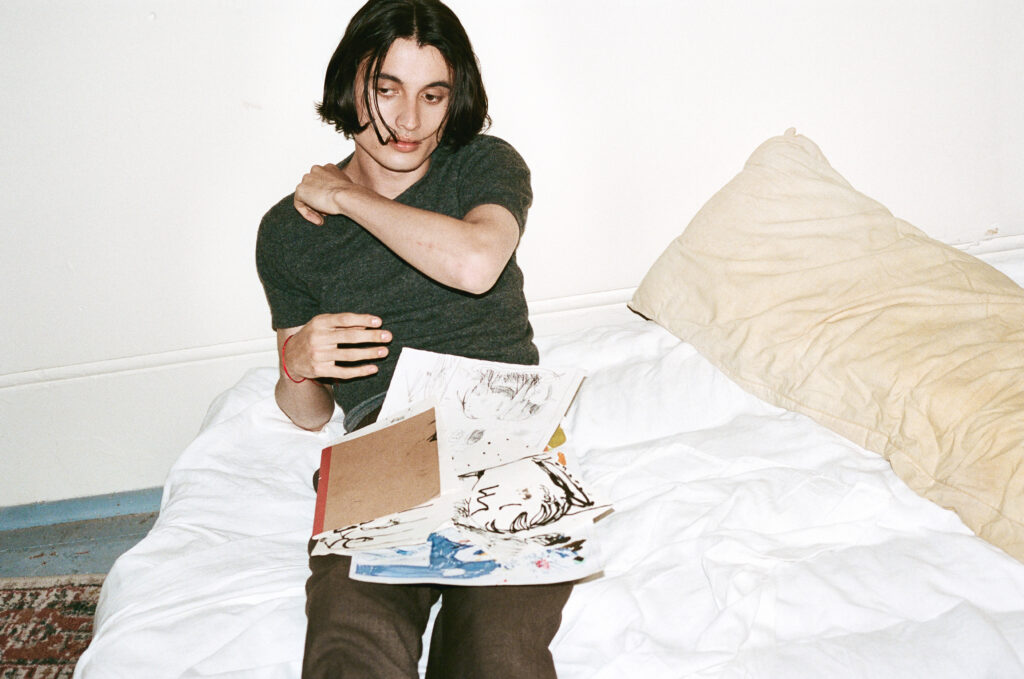
Photo by Joe Brennan
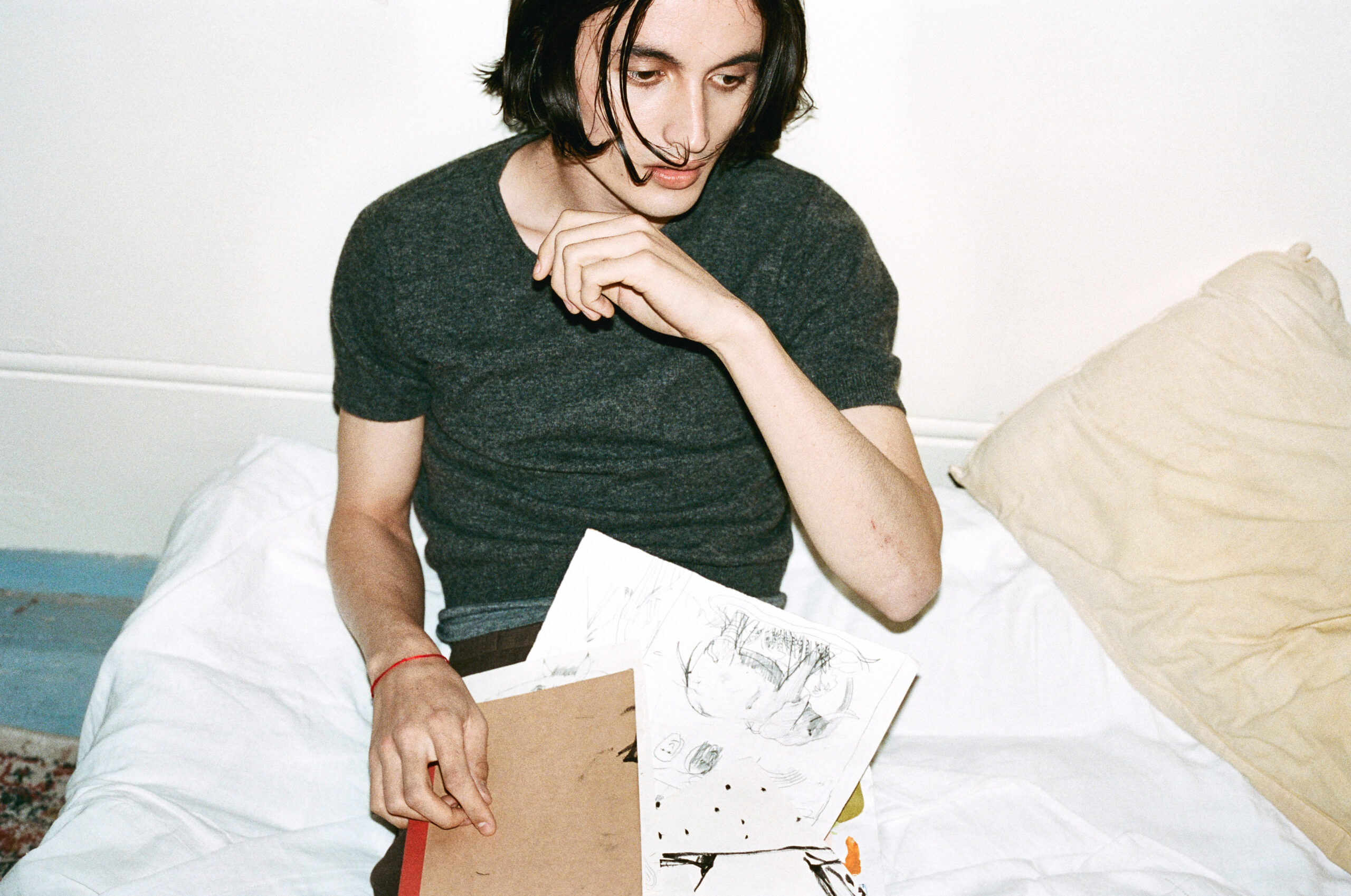
Sometimes you come across an artist, look at their work, their art, and the entire little world that comes along with their music, and think, oh yeah. This is someone who genuinely loves art. Someone who isn’t just making music, but is passionate about everything that comes with creating it. One of those artists for me is Nick Ward.
The Sydney-born songwriter, producer and all-round creative has a way of making music that feels like stepping into someone else’s imagination. If you’ve watched the music videos for ‘Jenny’ and ‘Piano’, you’ll know exactly what I mean. Both have landed themselves on my list of favourite music videos this year, and for good reason. They’re weird, they’re freaky. In a good way, of course. Everyone likes freaky good, right? There’s something about their handmade, slightly off-kilter approach that feels like a love letter to the wonderfully strange side of filmmaking. Think a little bit of the ’60s and ’70s, a little bit of retro surrealism, but with a world that feels entirely Nick’s own.
It’s an approach that carries over into his second album, Year Of The Snake, a 12-track record that takes its name from Nick’s birth year, 2001, the Year of the Metal Snake. Following his acclaimed 2024 debut House With The Blue Door, Ward finds himself in a much bigger and more expansive musical world, moving between baroque pop, electronic, soul, indie rock and classical influences. Written through what he describes as one of the toughest years of his life, the record explores heartbreak, friendship, faith and the slightly terrifying business of growing up, all while trying to hold onto a little bit of hope.
There’s something quite lovely about an album that can sit with the uncomfortable parts of life without losing its sense of wonder. With Year Of The Snake, Nick seems to do exactly that, building something that is just as ambitious and playful as it is personal.
I caught up with Nick a month before the album’s release while he was in New York, where we spoke about bringing his wonderfully freaky music videos to life, his love for film (and his Letterboxd Top 4), the myth of Orpheus, making music with friends, and, perhaps most importantly, his ongoing journey towards becoming a better sandwich maker.
Alana Ash (Cult Machine): Is New York how it is in films?
Nick Ward: It is, yeah. It’s actually crazy. Very iconic. Sometimes it feels like I’m the only one taking it all in. Everyone’s so busy going about their day, and I’m the only one staring and looking at how beautiful it is.
Alana: Your new album is out in a month. How are you feeling about it officially releasing?
Nick: It feels great. I’d say I finished it in May. That’s when we finished the mixing, so it’s still quite fresh to me. It’s nice not to have to wait. My first album in 2024 was done halfway through 2022, so it’s nice not to have to wait so long to put it out. It’s great.
Alana: What was the first spark of this album? What started it? Was it a song, a feeling, an image, or something completely random?
Nick: I think this album went through a bunch of processes. I probably honestly made four albums before it became what it is. I think I just had to go through a bunch of different phases of interests and stuff before I’d get bored and move on.
There were a couple of songs that still stayed relevant to me, like “Hands” on the album and “Year of the Snake,” the title track. But some of the earlier versions of the album were probably two years old.
Most of it was made within the last year, I’d say. I was going through a really tough time last year and just kind of reckoning with that.
Alana: Do you have any personal favourites from the album?
Nick: I really like “Piano,” but it kind of changes every day.
I also like “The Boy Who’s Seen It All”, especially now that we’re doing the live show and rehearsing for that. It’s nice to refresh the songs for myself.
Alana: When you’re making songs, do you take into account how they would sound or look live?
Nick: Yeah, I think usually I have to not think about playing live while I’m recording, just because it would stress me out too much. There’s a lot of stuff on this album that would actually be impossible to play live, so I had to try not to take it into account.
It’s kind of a luxury in 2026 that we’re able to do that. The Beatles had to stop touring for a reason.
Alana: I’ve read that you’ve spoken about wanting to make a happier album, but only to find yourself going through some difficult periods while making it. How do you make music that feels hopeful without pretending the darker parts of life aren’t there?
Nick: I feel like that’s pretty inherent to the human experience. Suddenly, your bubble of childlike wonder pops, and you’re kind of seeing the darker parts of the world. I think you have to try and hold on to what hope is worth.
It’s not something that was specific to making this album. I think it’s something I’ve just had to do in my life, and I’m sure pretty much everyone has to do in their life.
I think listening to the Beach Boys and the Beatles, they really tap into that kind of process. So many of the songs are, you know, “Let It Be” or “Getting Better.” There are so many songs that I think are very much confronting that kind of tension.
Alana: Are you a big Beatles fan?
Nick: Huge Beatles fan. Probably the first thing I found on my own.
Alana: I know you’re also passionate about film. How do you feel about the casting of the Beatles biopic?
Nick: Bullshit! I feel like these movies are going to suck ass. But I’m saying that with love because I just want them to be good, and I really hope they’re good.
I remember thinking that the Bob Dylan movie, the Timothée Chalamet one, was going to be really bad. Then I loved it, I cried so much, and I saw it twice. So I really hope that happens with the Beatles movie.
Alana: Hopefully! We’ll just hope and pray.
Nick: Yeah, fingers crossed.
Alana: Going back to the record, do you feel like you’re in a completely different chapter of your life now compared to when you started making it?
Nick: 100%. Again, I went through a really tough year, and I turned 25, so I think my frontal lobe has developed. I feel like I’m probably the happiest and most stable I’ve ever been in my life.
It kind of took going through all of that to get to this place.
Alana: Can we also talk about your music videos and the visuals in general? Because they’re insane, honestly. I love the music video for “Jennie,” and I love the music for “Piano.” How did you approach building the worlds for these songs?
Nick: I think with something like “Piano,” there are so many switch-ups in that song and so many moments that we could build scenes around. I think it was easier to do that for that song than it was for “Jennie.”
With “Jennie,” we had a tough time editing it because, for “Piano,” we kind of shot with the edit in mind. We had already edited it in our brains before we shot it. Whereas with “Jennie,” we wanted to experiment a little more, shooting a lot of different coverage and then working it out in the edit.
I don’t think I want to do that again because it was stressful.
Alana: But the result was amazing. I love it. It has a kind of freaky ’60s vibe, in a good way, obviously. We love freaky here.
Nick: It’s definitely freaky.
Alana: Were the ideas already there in the songs, or did the visuals kind of take on a life of their own?
Nick: The visuals took on a life of their own. I think “Piano” was probably more of a… I knew that I wanted things to feel really handmade and practical, and not too slick, I guess, for lack of a better term.
It had to be something crazy. I had to levitate or fucking…
Alana: Were you dangled to create those scenes?
Nick: Yeah! Oh my god, yeah. I was upside down for so long. That was creepy. It made me very light-headed.
Alana: It feels like stepping inside someone else’s imagination when you watch the music videos. Cool. Were there any films or visual artists that you kept coming back to while making them?
Nick: Yeah, I think we wanted everything to have this really handmade feel. I really loved Michel Gondry’s music videos, Chris Goddard, and a lot of stuff from the ’60s and ’70s. We wanted to achieve effects practically, whether through lens choices, filters, or just being sneaky with the camera.
I think we just wanted to keep it all really handmade, even if it came off as a little goofy. With everyone being able to make a relatively slick video now, with cameras and AI and whatever, I think we wanted to make something that had more of a job.
Alana: Definitely. Everything now is AI-generated, so it’s really good to see stuff being made by hand and actually feeling handmade.
Has anyone ever asked you your Letterboxd Top 4?
Nick: Yeah, not in a while. My Letterboxd Top 4 at the moment, I think, is Punch-Drunk Love, The Mother and the Whore, The Fly, and Tropical Melody.
Alana: And you’ve worked on film scores as well. Would you like to do another film? Or any more full film projects?
Nick: 100%.
Alana: Is there any particular kind of film you’d love to work on?
Nick: Yeah, I think it’s definitely something that I really want to move into. That’s a bigger part of what I do. It’s also a fun time for me. It’s really fun servicing someone else’s vision and trying to imagine different music ideas just from reading the screenplay and listening to the edit.
It was so much fun. Especially because it’s less stressful than having to work on my own stuff. You’re just trying to help someone make that movie, rather than worrying about what your own project is.
Alana: But is there a pressure of, “Oh, this is going to be seen in cinemas and on the big screen,” when making film scores?
Nick: Definitely. At the same time, you don’t even see the finished film until the day it comes out or the premiere. I was working on really early cuts of it, so it’s not that intimidating because the sound isn’t done, the edit’s not done, and there’s no colour grading. It’s not as intimidating, I guess.
Alana: Would you want to direct your own film instead of being the one who only makes the film score?
Nick: Yeah, 100%. I feel like I’m able to scratch that itch a little bit from helping direct the videos. But doing an actual project would be great.
I think I just haven’t found an idea that would sustain me long enough to go through the fucking nightmare of making a short film. We actually have one. It’s pending.
Alana: I read that a lot of this came from jamming with other musicians and letting the music dictate its own structure. I’m curious, was there ever a moment during recording when you had to resist the urge to step in and control where a song was going?
Nick: I mean, I definitely did. I didn’t resist that urge at all.
Alana: Because it’s your album, after all.
Nick: Yeah. I think sometimes I wish I could be less stubborn, but I don’t know. It’s just how I am.
That’s why I’m used to making music alone, so I think it stresses me out. I get it, though.
Alana: This is your music, this is your art. You have to have intention with it. I also read that you’ve experimented with some pretty unconventional recording methods. Building drum kits out of scrap metal, that’s cool. Do you approach these experiences more like a producer solving a problem, or like a kid seeing what happens when they break a toy apart?
Nick: Both, I guess. I think it’s probably the same thing. Production just happens to be my artistic special interest or whatever.
There’s definitely a level of, “How the fuck is this going to go down?” We’ve talked all this time, we’ve got a session drummer in, and he’s playing on fucking bin lids or whatever. There’s definitely a fear of, “Oh my god, what if this just goes horribly wrong? I have to scrap all of it.”
But I think that’s what’s exciting about experimenting and not being 100% sure of what the end result is going to be. I think it’s nice to be open to those possibilities rather than just mapping it all out from the start.
Alana: What was your favourite moment of recording this album, or the entire album process?
Nick: I really loved mixing, so that was really fun. Otherwise, we recorded an Indian percussionist who played on a couple of songs. That was really fun.
Obviously, the drum kit made of scrap metal was really fun. I guess having musicians, we had trombone players and horn players in the studio. Working with other musicians and literally just sitting back and listening to them play all the songs from the charts I’ve written. That’s so much fun.
Alana: Yeah, and you’ve spoken about how important your creative community has been to you.
What’s something a friend has introduced you to, whether it’s a record, a film, an artist, or anything, that maybe changed your perspective on something?
Nick: Yeah, I have a bunch of friends who put me onto a lot of stuff. My friend Zion Garcia showed me a lot of J Dilla that I really loved, and Madlib. My friends are always putting me onto stuff that I haven’t explored before.
Alana: Widening your taste.
I’ve also read in the album description that you connected Year of the Snake to the myth of Orpheus, which is really cool. Are you big on mythology and stories?
Nick: Not at all.
Alana: Oh, really?
Nick: For some reason, I just became obsessed with this one myth from the first time something like that happened in my life. I think it reflected a lot of what I was going through in my personal life, and I guess that’s why these stories stand the test of time.
People can find their own meaning and put their own projections onto them. I just randomly became obsessed and watched every movie that adapted that myth, and found a lot of references in other works of art. So yeah, I became really obsessed.
Alana: What made you initially discover the story of Orpheus and stuff?
Nick: It was the movie Black Orpheus, which is this amazing film. I’m going to say it came out in the ’50s or ’60s. It’s Prince’s favourite movie.
So I really loved that. There are literally so many Orpheus movies. There’s a whole lot of retellings. Jean-Claude Feu made a whole trilogy of them.
So I think it’s clearly a myth that’s been a favourite of a lot of artists. Especially because Orpheus is an artist in the story.
Alana: Myths in general have so many interpretations and retellings, so it’s really cool to see. The Odyssey. How did you like that?
Nick: I hated that movie.
Alana: Oh, really? What didn’t you like about it?
Nick: I just don’t fuck with Tom Holland.
Alana: Oh, shit. Okay..
If this album was a Greek myth on its own, what kind of myth do you think it would be? Would you be the hero? Would you be the tragic figure?
Nick: I’d be the jester.
Alana: Before I let you go, what’s something you’ve been wanting to try creatively that you haven’t had the chance to do yet?
Nick: Honestly, just make a dope sandwich. My sandwich game is very intermediate.
Alana: You need to get two pieces of sourdough bread and just stack it with sauces. I like to make a contrast between savoury and sweet, with jam. Strawberry jam is good paired with bacon. And then add some cheese. That shit is bomb. And add honey as well.
Nick: I think, in more than one way, I don’t have the sauce when it comes to sandwiches.
Alana: Sauce is very crucial to sandwiches. It’s very crucial.
Nick: Yeah, my sandwich is dry as fuck.
Alana: I’m sure you’ll get there someday. 2026 goal: before the end of the year, make a really good sandwich.
Nick: Yeah, maybe more like 2027.
Perhaps the best thing about speaking to Nick Ward is realising just how much of his world exists beyond the music itself. From building entire visual universes out of practical effects and handmade ideas to getting lost in old films, mythology and whatever his friends happen to introduce him to, there’s a genuine curiosity that seems to follow everything he does.
“Year Of The Snake” might have come from a particularly difficult chapter of his life, but there’s still so much playfulness, experimentation and wonder woven into it. And if there’s one thing to take away from our conversation, it’s that you don’t necessarily need to have everything figured out to make something worth putting into the world. Sometimes you just need to let things get a little weird, trust the process, and perhaps learn how to make a decent sandwich along the way. We’ll be holding Nick to that 2027 resolution.