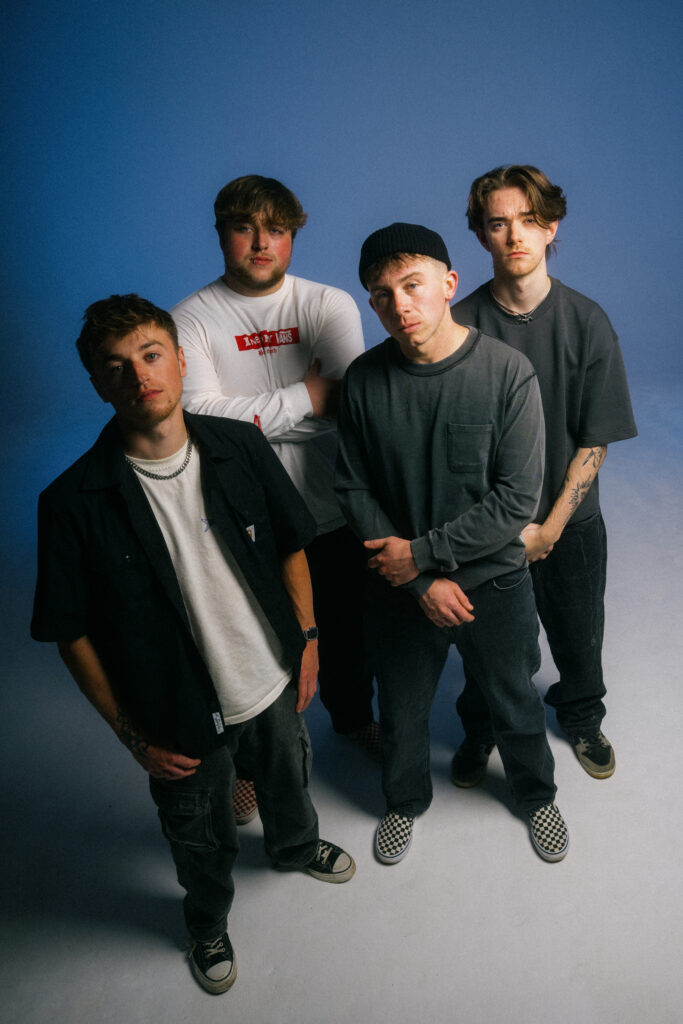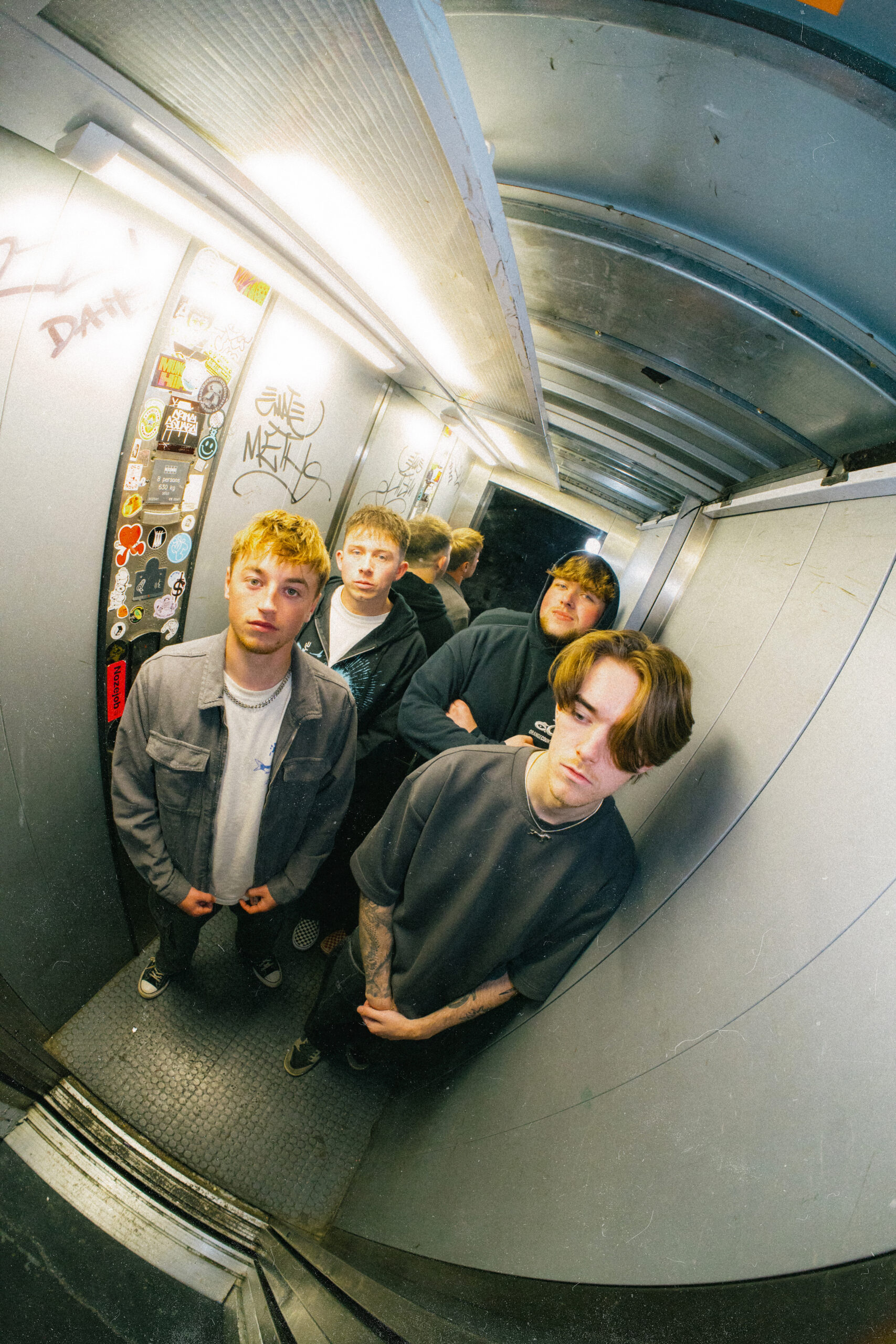
Photo by Sam Wingrove
For a band barely a year into its existence, Overgrown are moving at an extraordinary pace. Hailing from the Scottish Borders, and Newcastle, the four-piece – Callum Ter Morsche, Elliot Johnson, Marc Mitchell and Mike Essery – have quickly found their footing with a sound that looks back to the heavier side of the 2000s. Drawing on the melodic grit of Deftones, Chevelle and Silverchair, their nu-metal, grunge and shoegaze hybrid feels both nostalgic and distinctly contemporary.
Their latest five-track EP, ‘Waiting Room’, released in October, has accelerated that momentum, with tracks amassing millions of streams and the band reaching two million monthly Spotify listeners. Having already shared stages with Dead Pony, YONAKA and Alter Bridge, as well as appearing at festivals including Slam Dunk, 2000 Trees and All Points East, Overgrown are quickly graduating from the local circuit to much bigger stages. Next up is a UK and European run supporting nu-metal veterans Sevendust.
We caught up with the band to discuss their beginnings, the unexpected success of ‘Waiting Room’ and what comes next.
You’ve only just formed as a band last year – how did you first meet, and what led you to start making music together?
Marc: Mike, Callum and I were in a band together before this. I’ve known Callum for about six years, and we met Elliot through a previous band of his. When Callum started putting music out on his own and it began to take off, we brought together a group of people we already knew. That’s how it all started.
Elliot: Those guys had been playing together for at least six years, and I’d spent the best part of a decade in two different bands, playing loads of shows. I think people assume Overgrown is completely new and that everything happened overnight, but we’ve all been playing locally for years. It’s actually quite nice to explain that side of things because most people don’t know it.
Your latest EP, ‘Waiting Room’, has taken off, with tracks racking up millions of streams and the band reaching 2 million monthly listeners. How has seeing this response changed things for you so far?
Elliot: In terms of our dynamic and how we approach things, nothing has really changed. It hasn’t altered the music we like or how we make it. We’ve always been drawn to this style, and we’ve never tried to tailor our songs around streaming numbers. The response has been an incredible bonus, but we have no intention of changing what we do just to keep those numbers growing. We’d rather stay true to the music we love making.
It still blows our minds every day. We never expected this kind of reaction, especially after spending the best part of ten years playing locally. The three guys are from the Scottish Borders and I’m from Newcastle, so there isn’t a huge amount coming out of our respective areas in the rock world. We’re just incredibly grateful.
Your sound draws on the nu-metal and alternative rock of the 2000s, with bands like Deftones, Chevelle and Silverchair as reference points. What first drew you to that era of music, and how do you approach making it your own?
Marc: I started out listening to Nirvana, but as I got older I discovered bands like Silverchair and Deftones. I suppose I grew up listening to music from about twenty years before my time. Over the last six years, I’ve also gotten more into nu-metal bands like Limp Bizkit and Incubus. Callum and I have always had similar tastes, so a lot of it stems back to Nirvana and the bands we discovered through them.
Elliot: For me, it’s the guitar tones and drum mixes on those records. They’re incredibly raw and carry so much emotion. A lot of modern music can feel overproduced to me, whereas I love those raw, slamming drum sounds and the character they bring. I’d rather something feel less polished but have real emotional weight and energy.
We definitely wear our influences on our sleeves. A lot of what we’re known for comes from those clean-picked riffs, and Callum is a brilliant riff writer. Most songs start with him bringing in a rough idea or a full demo, which we then build on together in the practice room. His influences, particularly Wes Borland, are quite obvious in some of those riffs. It’s about taking those influences and interpreting them in your own way. The other guys are all incredibly capable musicians, and having everyone bring their own abilities into the writing process makes it really exciting.
Marc: I’ve noticed that Callum will listen to a band, take something from it and then sit down and write. Sometimes he’ll come up with something that sounds like a band he’s never even listened to. It’s almost subliminal.
‘Breathe’ remains your most-streamed track, while ‘Waiting Room’ seems to have introduced your music to an even wider audience. How do you feel your songwriting has developed between the two releases?
Marc: Initially, ‘Breathe’ was entirely Callum’s creation. Some of the newer material still starts with him writing a demo, but now we’re all adding our own touches. The first five songs we released were written and recorded by Callum, and we essentially played what he sent us. Now we’ve got three more perspectives involved in the writing process.
Elliot: Marc summed it up well. What started as a solo project has gradually become something much more collaborative. We’re still trying to preserve the original vision of each song, but now we’re bringing our own ideas into it.
You’ve played some major festivals this year, including 2000 Trees, Slam Dunk and All Points East on the day Deftones headlined. What has been a standout moment from playing these festivals, particularly alongside artists who have influenced you?
Elliot: All Points East was a bit of a fever dream. We arrived early, before anyone else was really there, and were walking around the site when Deftones came out to soundcheck. We just stood there in amazement, taking it all in. It’s one of those rare moments you don’t usually get to experience.
The show itself was incredible. I remember walking out and looking at the crowd, thinking I’d be happy with a couple of hundred people at the front. Instead, there was a sea of people as far as I could see. It’s every musician’s dream to play to a crowd like that. It was quite emotional, actually. I remember addressing the audience and feeling my throat start to tighten, so I had to hold it together. There was a huge mosh pit and people were coming over the barriers. It couldn’t have gone better.
You’ve already toured with bands like Dead Pony, YONAKA and Alter Bridge, and you’re about to join Sevendust for their UK and European tour. What have you learned from sharing stages with such different artists, and what are you hoping to take from this next tour?
Elliot: Playing with more contemporary bands gave us a real insight into how the modern touring world operates – everything from their pre-show routines to soundchecks and how they carry themselves as headliners. They were all incredibly gracious and welcoming.
Alter Bridge was a much bigger operation, with multiple trucks, buses and a huge crew, but they were just as welcoming. They’re legends in our world. Mark Tremonti is such an iconic guitarist, and Myles Kennedy had absolutely no ego. They’d come over, say something kind and were genuinely easy to work with.
More than anything, it’s shown us how important it is to treat people well. Regardless of how big a band is, everyone needs to get along for things to run smoothly. I was nervous before our first tour with Mouth Culture because I thought they were so cool, but within five minutes of meeting them, those nerves disappeared. Everyone we’ve played with this year has been so kind, and that’s something I’ll carry with me.
Marc: There’s nothing worse than turning up to a venue and having a horrible experience with the sound engineer. Those little things can make or break a night. I also loved seeing the behind-the-scenes side of Alter Bridge, particularly the gear they use. Although we’d all played in bands before, Mouth Culture was our first proper tour, so we didn’t really know what to expect. It was a brilliant learning experience.
Coming from Scottish Borders and Newcastle, you’re building a following that now reaches far beyond your local scene. How has where you’re from shaped the band, and do you still feel connected to that community as things grow?
Marc: We’re from a small town, and our previous bands never really seemed to fit in. We were either considered too heavy or too indie-focused. Our hometown is probably Newcastle, so I’ll let Elliot speak more about the local scene there.
Elliot: I’ve played in bands around Newcastle for years, and I still go to local shows. I feel really connected to the scene, and the people I’ve met along the way have shaped my musical journey. In fact, my previous band once booked Marc, Callum and Mike’s old band as the opening act for their first-ever show. That’s how we initially connected, and we’ve played plenty of shows together since.
Musically, I’ve always felt somewhere in between. My first band was very indie-focused, which wasn’t quite my thing, while the next was heavier than I wanted it to be. Overgrown has landed somewhere in the middle, in that alternative rock territory I’ve always loved.
With the success of ‘Waiting Room’ and the Sevendust tour on the horizon, what feels like the next step for Overgrown? Are you already thinking about new music, and where would you like to see the band a year from now?
Elliot: We’re always writing, and there’s new music taking shape that we’re really excited about. We’d also love to play our first headline shows next year. We haven’t worked out the details yet, but it’s definitely something we’re planning towards.
Honestly, I don’t have any particular expectations for where we’ll be in a year’s time because I’m already living my dream. This is more than I ever thought I’d get to do, and I’m grateful every day that I can make music with people I love. I’ve actually had to take a six-month career break from my retail job because I’d used up all my annual leave and couldn’t take any more time off during the busy November and December period.
I’d also love to have a guest vocalist feature on one of our tracks. We’ve talked about bringing in a really big voice for a chorus, perhaps someone from the heavier side of music. We’re open to different possibilities, but it would be exciting to explore.
Marc: Anything else that comes along is a bonus. I’d just love to have an even busier year next year and hopefully get to a point where music can become our full-time job. We’d also really like to tour America. A lot of people actually think we’re American! Callum spent loads of time watching YouTube as a kid because he lived in the middle of nowhere, so I think his accent has picked up a bit of an American influence.