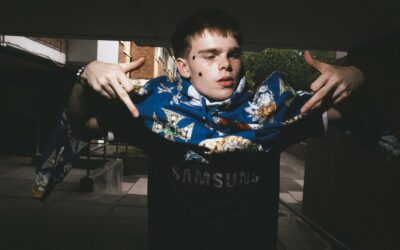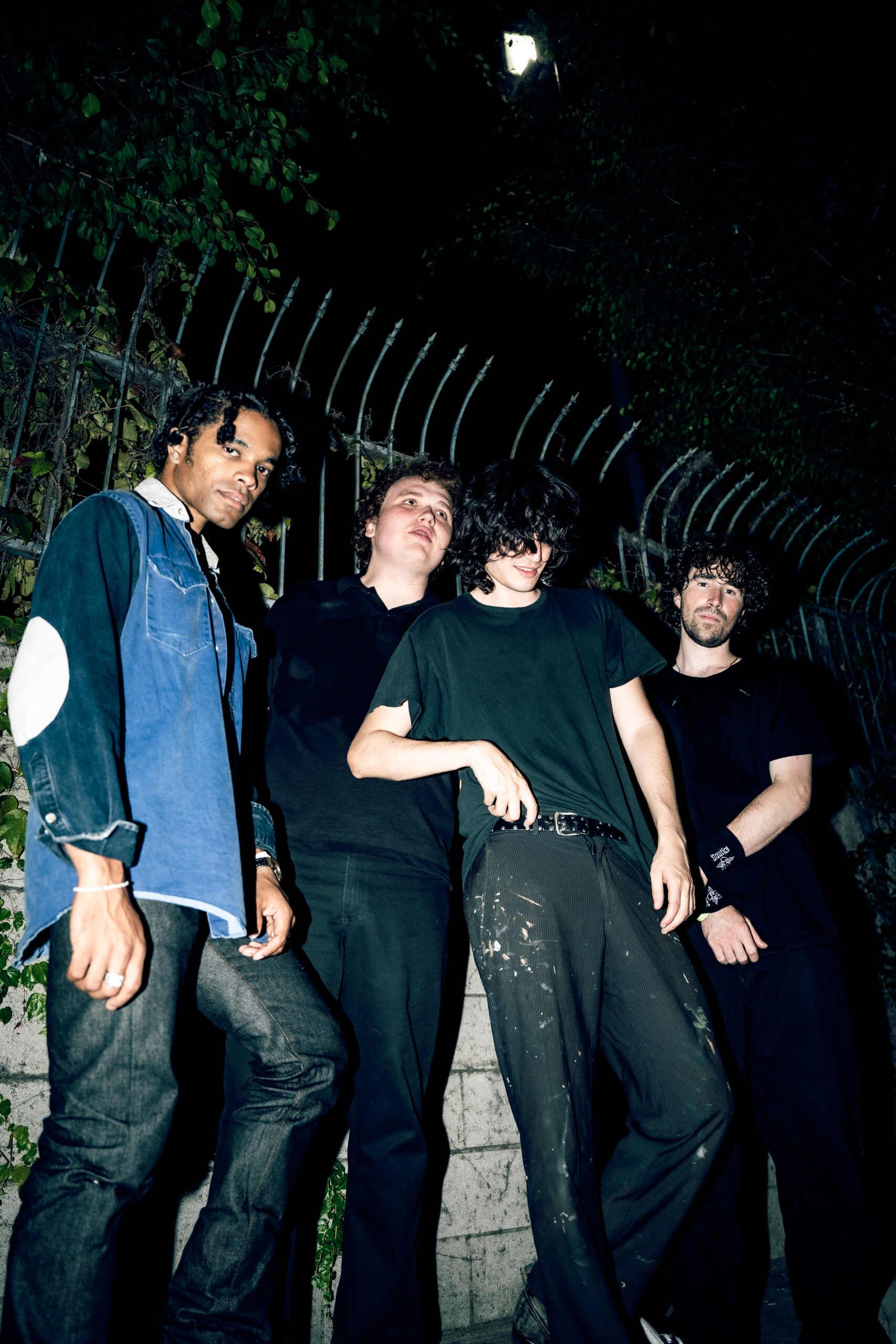
It’s a pretty good time to be a rock band in New York City. There’s a show almost every night, to which half of them are free, and a new generation of bands keeping the city’s sweaty, chaotic, slightly unhinged show culture alive. Amongst the bunch are Nautics–four friends who met in high school, started making music together as teenagers, and have spent the last 11 years figuring out exactly what kind of band they wanted to be.
Kenzo Repola on vocals and guitar, Van Cameron on bass, Kitt Flamer-Calder on guitar, and Levitt Yaffe on drums–all born and raised in New York and all still making music together more than a decade later. Their sound has the kind of 2000s indie-rock sleaze that might make you wonder if you’ve accidentally stepped into an old Strokes video, only for the band to pull the rug out with electronic textures, pop instincts, and a little 80s/90s DNA underneath it all.
After years of tiny rooms, DIY shows, sold-out nights at Mercury Lounge and a headline at Bowery Ballroom, Nautics are finally putting a proper timestamp on everything they’ve built together. Their debut album, People Only Like Me When I’m Leaving, is a messy, melodic snapshot of relationships, loneliness, social anxiety and the strange experience of being a person. Split between the physical rush of a rock band and a more electronic, experimental second half. It’s part new beginning, part decade-long time capsule.
Ahead of the album’s release, I caught up with Kenzo to talk about growing up in New York together, writing almost telepathically with your best friends, the weird pressure of carrying on the city’s rock lineage, and why sometimes you just have to go on dates with your homies.
Kenzo Repola: We’ve been together for 11 years. So this is sort of like a big undertaking that we decided to do and I felt like it was the right time, as we were sort of building more of an audience and a fan base.
I think it was nice to have more people to share with, and hopefully we have more people to share with after it comes out. I think it’s a good identifier for how we are musically now, which I feel great that I can do that and feel confident that it’s like one project.
Alana Ash (Cult Machine): After you guys have been together for so long–more than a decade now! Does releasing this album make you feel like you’re starting a new chapter or is it more of you documenting something that’s existed for years?
KR: I think there’s a bit of both. The decade of being together was super important to where we’re at now. There’s a lot of that in what we’re doing. And like I said, I think we got a little bit more clarity in the thing we’re doing.
It kind of feels like a new introduction and kind of feels like a big statement piece of what we want to identify as now.
AA: The title, People Only Like Me When I’m Leaving. How’d you decide on that title?
KR: As I do lyrics and do a lot of the verbiage for our band, as the singer, I think a lot of phrases come to mind and I kind of just write them down in a little book or my Notes app, or on an old receipt paper, anything that I can find when I think of an idea.
When we were kind of in the beginning stages of making the album.. A lot of songs weren’t even written at this point. Then that phrase kind of came to mind. It just kept coming into my head, that like, people only like me when I’m leaving. It was kind of a mouthful.
It looked really nice. It kind of evoked sort of this kitschy kind of loneliness that I think is present throughout the album. I think there are a lot of themes of loneliness and isolation, and not wanting to leave the party that you’re at, or social anxiety in general, or just being a person.
That phrase kind of was right all along for all the themes.
AA: The entire process of the album, did you completely start from scratch? Or did you reuse or take old songs you’ve demoed in the past?
KR: There are definitely songs that were old demos that we adjusted. There’s certain riffs, like Holding On to You, that was like a riff that I made in high school–or It might have been middle school.
But then there are also songs where we came up with them, tracked them, mixed them within the span of like a week or a couple weeks. So it was kind of a mix of old and new. I think a lot of the ideas were super current, and then a lot of the production elements of it and the idea that we had, even if the song base was kind of older, was a lot more adjusted to how we think about making music now, if that makes sense.
AA: When you listen back to the older vision of yourselves, what do you feel is most different about the band now?
KR: I think you can hear that we’re more confident. Vocally, I have things that I like doing. I feel comfortable in, like, having a way in which I kind of naturally will sing and perform now and think about things lyrically and structurally that maybe when you’re in middle school or high school writing songs, you’re kind of just trying to imitate who you look up to.
I think now I can kind of finally say that I have a thing that is distinctly Kenzo, and we have a sound that I think people can identify as Nautics.
AA: Describe your sound in, like, three words.
KR: Three words? Really, really good.. (laughs)
No–I would say that it is emotional, energetic, and fun.
AA: I was actually playing Wasteman on the TV recently, and my mom walked in and thought you guys were a band from the 2000s.
KR: That’s awesome.
AA: There’s definitely something about your sound and even your whole aesthetic that feels like it could have come from that era. Do you think that’s something you kind of gravitated towards, especially with your influences and bands you guys grew up listening to?
KR: Yeah, there was a cool sort of renaissance of bands from that era that a lot of people take influence from. We have a lot of influence from that era, but I think we also have a lot of influence from the era that those bands were influenced by.
Because we like a lot of 80s and 90s music, which is what bands in the 2000s used to listen to, I probably listen to the same music that Julian Casablancas listened to when he was, you know, 20-something. I can see where the parallel is.
AA: And playing in the same city that gave us The Strokes, Interpol, Talking Heads, all of these amazing New York bands. Do you ever feel that history when you’re making music here? Or is it so embedded in the city that you don’t really think about it?
KR: We’re all born and raised in New York City. We don’t think about it so actively, but we’re just grateful to maybe be part of the discussion, part of the lineage of other bands that came out of the city.
As a New Yorker, especially one that’s born here, you feel an obligation to represent and not only appreciate your home team, like the artists that come from here, but also to try as best as possible to add something new to the discussion whenever possible.
And maybe there is a sound that is of New York, but I think we try to bend it a little bit here and there as much as we can while sounding good still and fun.
AA: There’s so many amazing bands coming out of the city. Do you feel like there’s currently a really important moment in New York rock?
KR: I think there’s a big culture about going to shows and going to see bands now, and an openness to trying new things. There’s a show kind of every night. There’s multiple shows every night.
Half of them are free. Why wouldn’t you go out and look at something new? So I think it’s just kind of a bigger pool now. There’s more of an opportunity to try out new things and to see new things as an audience member.
Especially ever since the pandemic, I think people were desperate to go outside and make connection and tell someone that they have a cool jacket.
AA: There’s clearly a big relationship between the band and the physical experience of seeing you guys live. When you’re writing or recording new music, especially for this album, do you think about what a song is going to feel like when you’re playing it in a room of people?
KR: There’s always an element where we rehearse as a band. In terms of the production, we split the album into two, where half of the album is sort of like, it’s a rock band. The second half is a little bit more electronic-influenced and pop-influenced.
So with that, with the first half we had to rehearse it a lot and play it live and record it live. And the second half, we kind of experimented with what happens if we just kind of ignore the physical possibility, and then kind of reverse-engineer a song out of that.
But we’re honestly finding that whenever we retranslate the more electronic songs live, they’re still really fun and good.
We have this song, Bum-A-Cig, when we do it live there’s a kind of more rock and heavy, almost kind of like Ramones style to it that is really fun to play. I think both can exist.
AA: And you’ve played everywhere from tiny all-ages rooms to the Bowery Ballroom and Mercury Lounge. Is there something about those tiny shows that you hope never gets lost as the room gets bigger?
KR: We’ve played really intimate shows. Our first show was like five people in the room–you could literally have a conversation with every single person. Then we played to like 800 people, and hopefully even more soon.
I think you engage a little differently, but it’s important to remember that everyone’s there in the room with you. We try to be as present as possible and willing to kind of fluctuate with the vibe of the audience and kind of feel we’re all in this show together.
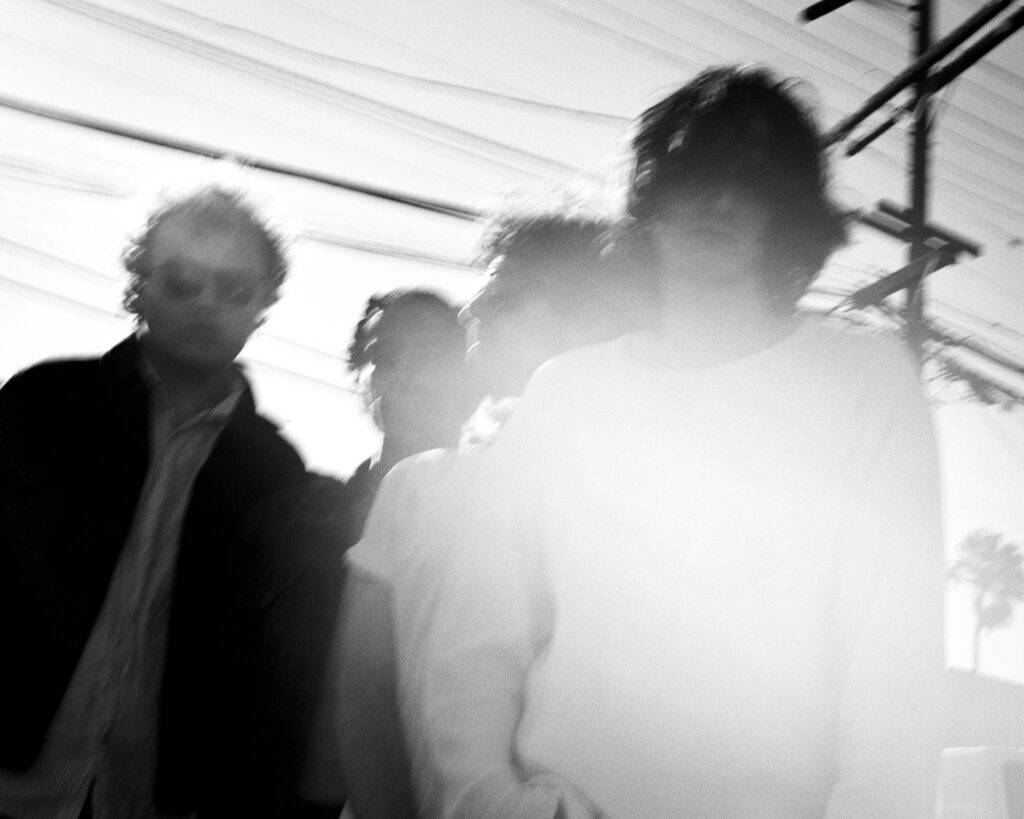
AA: You’ve played so many shows, is there a moment from a past show that’s stuck with you?
KR: We did a two-night residency at Mercury Lounge, and it was a big, huge show. I’m not trying to brag, it was sold out and it was great.
It was such a big moment because we set them up and orchestrated all the bands, and did all the promotion. It felt like a big graduating moment for us as a band from New York, because that’s a pretty important venue.
I was kind of show-obsessed like, you want to do the best job you can to put on the biggest show.. And going through that experience of stressing out over those two shows, our whole team was freaking out–Bands dropped out and re-entered, there was so much drama.
In the end, the biggest takeaway was the relationship that I gained with working with the venue, working with the other bands. We all were able to sit with each other before each show and we had really beautiful discussions in the green room, just about doing music and how proud we were of each other.
That was such a beautiful experience that really reminded me of why I love doing this and what the most important thing of being in a band is, which is the community and making art with other people.
I still hold on to those shows now because I think it just keeps me grounded.
AA: Did you ever imagine taking this band this far?
KR: I mean, you dream of everything. I would—not really joke— but I always say my sort of lofty goal is to play Madison Square Garden.
You have these big dreams and you kind of hope that you’re going to be a world-touring, cool rock star. You kind of just take steps and things arrive and people meet you when you kind of least expect it.
I’m just happy that it’s such a part of my life. I’m just grateful that it’s my life.
AA: Madison Square Garden in two years’ time. Amen.
KR: I think that’s honestly good! You should be there.
AA: Reserving my seat now.
You guys have known each other since you were teenagers, which means you’ve watched each other grow and change while still being in the same band. Has that ever changed the way you write together?
KR: Hm.. I think that this is the only music project that I’ve ever been a part of. I’ve never been in another band. It kind of just is my reality to me.
I think that being together for so long has made the sort of shorthand of what we like and don’t like and want to explore within the process of making music a lot less verbal.
Even when we jam and come up with ideas in a way where we don’t have to talk to each other about it anymore.
AA: Just telepathic.
KR: Yeah! We almost write telepathically. We know what each other’s tastes are now, where if we do something too out of line, we notice that the other person’s like, “Well, that doesn’t sound so good.”
In the last few years, we’ve become a lot more open with ideas that each other brings. It’s kind of twofold, where we’re just a little bit more willing to try stuff that maybe we didn’t think worked in the past.
AA: Everyone seems to have all of these different creative outlets, creative interests outside of the band. Has something one of you became obsessed with or interested in unexpectedly changed the direction of the band or influenced the band in some way?
KR: Yeah, for sure.
I grew up doing a lot of theatre and plays and shit like that, and kind of big production things like lighting and sets. I think that the theatrics kind of play into our performance in a lot of ways.
Van is a really excellent photographer. He shows me a lot of stuff and a lot of different compositions and ideas visually. We both like to go to museums and galleries together on our little dates.
We like to share ideas in that way. Especially in the last few years, I’ve been a lot more open to his visual identity and aesthetics. It’s definitely helped our band kind of form the kind of vibe it has now.
AA: Go on dates with your homies to keep a good relationship.
KR: Always go on dates with your homies. Forever and ever. Go on dates with all your homies.
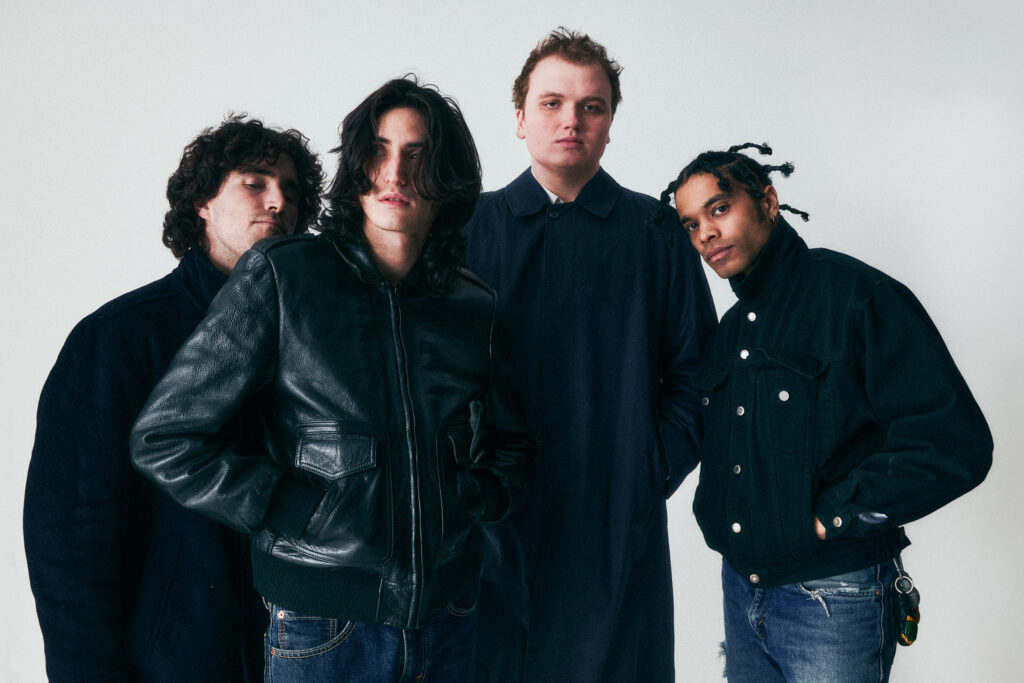
AA: You spent years building this thing in New York, in bedrooms, basements, tiny rooms and bigger rooms. And now you’re putting it out into the world. What part of the band still feels untouched by everything that’s happened around it?
KR: This sounds so corny, but we’re really like a family in the sense that you can only get it with the amount of time that we have been together.
These people are just such a part of my life that it’s kind of like no one else is as important as our bond with each other. We can always talk through things, and we fight all the time. Like, consistently having an argument with your siblings.
We were in the tour van once and we argued the entire time. And we would have a thing called the grumpy tax, where you have to put a dollar in the jar every time you were talking out of line, if you were being too aggressive with everyone.
AA: Like a curse jar?
KR: Like a cursed jar, but with attitude.
..I did have to pay the most, I will say. But I love my band so much, this is the only band I could really ever imagine being part of. I love touring with them.
AA: You guys are actually playing a show for Halloween. Are you guys gonna pull up in costumes?
KR: Yeah, we’re talking about it right now. I can’t spoil what we’re gonna be wearing. There’s one that I don’t think is a good idea, but the whole band thinks it’s a good idea.
AA: Is it gonna start another fight?
KR: (laughs) If everybody really wants to do it, I’ll find a good character to be in the franchise. But I won’t say more than that.
AA: Is there a personal, favourite song that you’re waiting to play out?
KR: We’ve been playing stuff on the new album on tour.
I really like playing Lie About The House. Bum-A-Cig.. Wasteman’s great. You’re playing it for your mom.
AA: (laughs) Yeah, I like playing music videos on the TV, and then she walked in and she thought she missed a band from the 2000s.
KR: Thanks, Mom. That one’s really fun live.
I like to think we do everything really well live. But that one is like super rock and roll.
AA: Do you have a personal favourite track on the album? Maybe one that has a more meaningful story behind it to you?
KR: Holding On to You. The one where I wrote that riff when I was in middle school.
The seed of that idea goes all the way back to the beginning of when we were in this band, and to kind of see how that song transformed. I kept not liking the vocals so I had to keep re-doing it, and I was able to get the way I wanted on the week of submission.
AA: Like a school assignment?
KR: Yeah, it was kind of down to the wire that bad. It was that crazy.
It felt like it was brewing inside me for the last decade and it was really nice to feel really good to accomplish it even at the last second. I think it’s a really beautiful song.
For all the noise, ambition and restless energy surrounding Nautics, perhaps the most beautiful thing about the band is how little their foundation has changed. They’re still four friends who grew up together, still figuring things out in the same room, still arguing in tour vans and apparently charging each other a “grumpy tax” when things get a little too heated. After 11 years, they’ve reached the point where they barely need to explain themselves to each other–they almost write telepathically, carrying a decade of shared taste, memories and growing pains into every song.
People Only Like Me When I’m Leaving feels like a culmination of that relationship, but not a conclusion. There are old riffs meeting new ideas, bedroom recordings turning into a full-length record, and songs that have been quietly brewing since Kenzo was still in middle school finally finding their way into the world. It’s a record about messy relationships and lonely nights, but also about staying with your friends, your city, your art, and the version of yourself you’ve spent years becoming.
Perhaps that is what renders Nautics so unmistakably New York. It isn’t just the raw guitars, packed venues, or the musical heritage they carry, but their refusal to trade intimacy for elevation. They show that you can scale up without losing your roots–eyeing Madison Square Garden while holding close the backstage conversations and five-person crowds that got them started. A decade into their journey, they still move with the hunger of day one.
Listen to their debut album now on all major streaming platforms, and if you’re anywhere near one of these cities, make sure to catch Nautics live. The band are currently on the road for an extensive run of dates, supporting Telescreens and Porch Light along the way—including a hometown stop at New York’s Bowery Ballroom on November 8.
September 25 — Charlotte, NC — Snug Harbor*
October 8 — Portland, OR — Holocene*
October 9 — Seattle, WA — Baba Yaga*
October 10 — Boise, ID — Shrine Basement*
October 12 — Salt Lake City, UT — Kilby Court*
October 14 — Denver, CO — Lost Lake*
October 16 — Minneapolis, MN — 7th St Entry*
October 17 — Chicago, IL — Schubas*
October 18 — Cleveland, OH — Foundry*
October 20 — Detroit, MI — Lager House*
October 30 — Charlottesville, VA — The Southern#
October 31 — Philadelphia, PA — The Foundry#
November 2 — Toronto, ON — Longboat Hall#
November 3 — Montreal, QC — Bar Le Ritz#
November 4 — Burlington, VT — Higher Ground#
November 7 — Boston, MA — Brighton Music Hall#
November 8 — New York, NY — Bowery Ballroom#
*supporting Telescreens
#supporting Porch Light