I’ve always had a great admiration for the Irish scene. Music, literature, culture–some of my favourite musicians and writers have come from the island, and there’s something about the way Irish creatives carry where they’re from that I’ve always loved.
And there’s certainly no shortage of reasons to. From Fontaines D.C. and Kneecap to Bleach 9:3, Florence Road and the countless artists bubbling up with, Irish music has never been short of people proudly carrying their beautiful home.
We’ve spent plenty of time watching the UK underground take over the internet, with artists like Fakemink, Jim Legxacy and EsDeeKid finding audiences far beyond Britain. But I think it’s time we look a little further west.
In strides Earfzilla, Dublin’s self-proclaimed (and internet-dubbed) best kept secret.
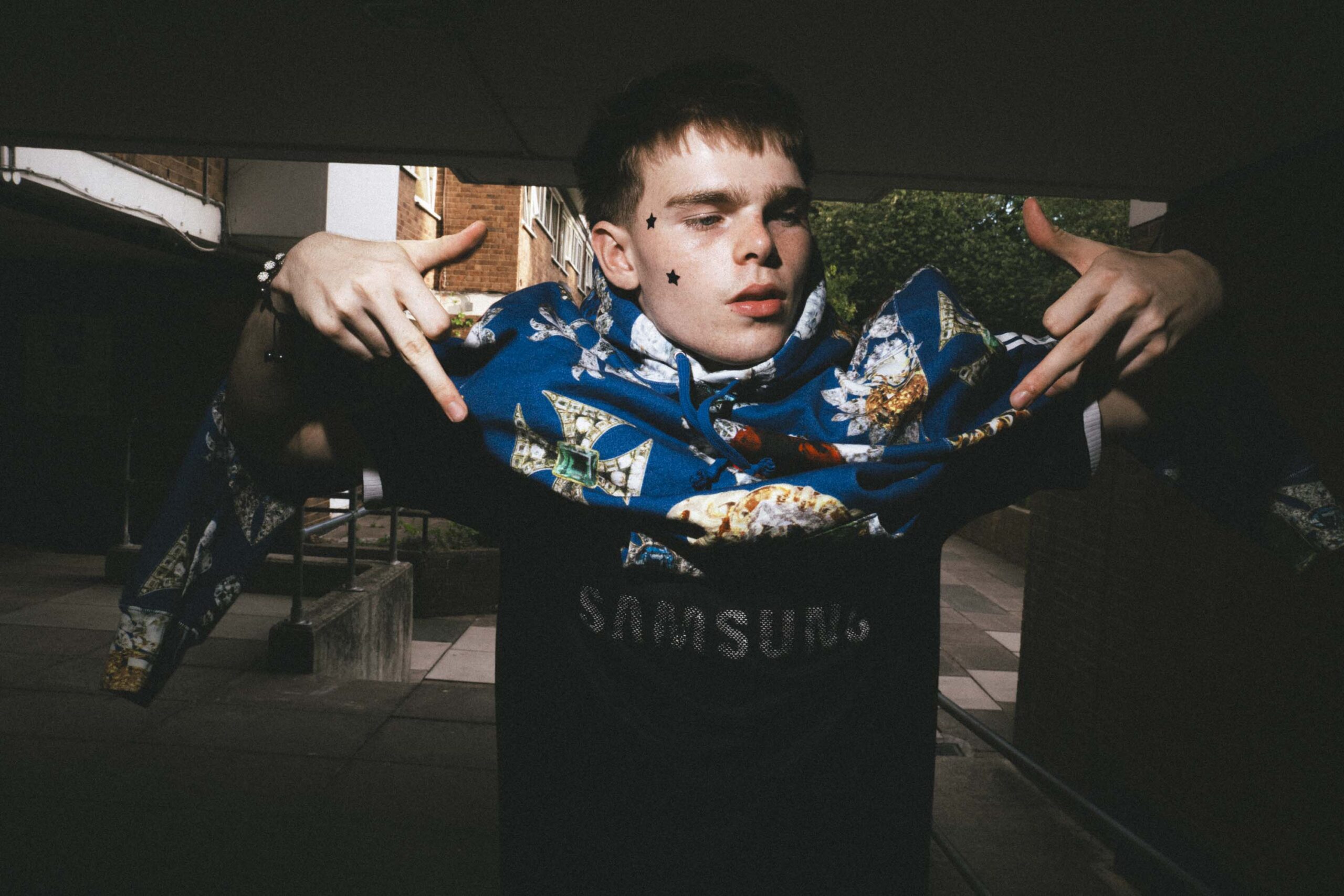
Freshly 18, Earf had just returned from a camping trip with his friends and a month in London, where he’d been working on a secret (but huge!) project. We spoke about what it means to be Irish in today’s world, his roots, internet generation, world-building, identity, and why, for Earfzilla, all of it is really just different ways of telling the same story.
Earfzilla: I was in London for like a month and two weeks. My mates came out with me, and then the other two weeks I was by myself. It was very, very eye-opening. I guess London is the step up from Dublin, and I guess LA and New York are next. But yeah, London’s definitely miles ahead of Dublin.
Alana Ash (Cult Machine): Can you tell a little bit of what you’re actually getting up to?
E: I’m definitely working on a big project.
I think the best thing I can say is that in the current underground scene, and for any sort of artists trying to express themselves, quality is important, but so is quantity. With me, I only have just about five songs out right now, and it’s not enough to really show people who I am, what I want to say, what I have going on in my mind, and who I am as a person and as an artist. So a project is definitely the move because I want people to be able to really delve into a whole world.
I want people to be like, “Oh, I get what this guy’s about.” All the announcements are coming very soon, and it’s very Irish-driven. That’s why I’m back in Dublin, because I gotta do all the content.
I think it’s very important to just stick with the roots as long as you can.
It’s important to me that this is a Dublin project and it all comes back to Dublin because that’s what’s most important. Obviously, going to London is cool to make the music because of the productivity and the workflow, and I have a lot of Irish mates, really talented creators from all over the place that I’m acquainted with in London. But in terms of actually putting out the project and sending it out into the world and onto the internet, I think it all needs to happen from Dublin because that’s the home base.
A: Everyone’s all up with the UK underground scene, but I feel like we need to also highlight the Irish scene, right? What’s something you think people haven’t really fully grasped or completely understood about the Irish underground right now?
E: I think that for me, meeting people from other countries and even from London, Ireland gets this weird type of aura for some reason. I think it’s the whole thing where we’re on an island and we’re kind of by ourselves, even though we’re right next to the UK and England and everything.
I think our scene is kind of different because people are figuring out what does it mean to be Irish in this type of world.
It’s very easy to know how to express being Irish in folk music and traditional music, and even pop music, with someone like CMAT or something. And you obviously have Fontaines D.C. and all these amazing bands.
I think it’s very easy to express Irishness from a world that is inherently Irish, but then when it comes into something that’s more the internet generation, I think what’s interesting is how everybody’s kind of trying to figure it out. People know what they’re doing and stuff, but it’s a little bit more confusing, I guess, to figure out how we can fit being Irish and show our differences in this internet generation.
People lose identity on the internet because we all just feel like the same kind of user. We all just feel like another username or another gamertag. It’s very hard to kind of remember the real world when you’re online so much. That’s what I’m trying to say.
Trying to find the balance between being online, being in real life, and then also trying to get America and England and the wider world to understand what being Irish is, without trying to lead into any stereotypes or clichés.
I just want to show you what being Irish actually is, in the casual way that we see it.
A: Do you think that you could make Earfzilla anywhere else?
E: I don’t know what it would be if it wasn’t from Dublin. I don’t think it needs to be. I have a big belief in all types of people that really inspire me. They’re world builders. I’m doing world building, and I wouldn’t say that being from the place you’re from should be the be-all and end-all of who you are and your identity, but I think it always plays a huge role.
It’s more of a foundation than the cherry on the top of the cake, you know what I mean?
Even with Rejjie Snow, who’s obviously an Irish rapper and a huge inspiration to me, he’s a Dublin rapper, but you would never really lead the conversation being like, “Oh, he’s an Irish rapper.” And even if you did, it isn’t in the same way.
Or even A$AP Rocky being a Harlem rapper. Nobody’s really like, “Oh yeah, he’s a Harlem rapper.” He’s A$AP Rocky. or Yung Lean being from Sweden.
From the jump, I’ve wanted the same thing with Earfzilla, where it’s like, yeah, he’s an Irish rapper or a Dublin rapper, but that’s more so part of my world and part of the story and the lore than it is a label, if that makes sense.
It’s just another aspect of what builds this world. It wouldn’t make sense if I wasn’t Irish because it’s inherently Irish, it goes back to world building. At the end of the day, if you want to build a world, you’re like, Earfzilla lives in Earfzilla’s world, A$AP Rocky lives in his world, Yung Lean lives in his world, and Rejjie Snow lives in his. Part of that world is being Irish.
A: Visually, talking about world building, I know that you’re also a painter. If you think about Earfzilla as a visual world, what would it look like?
E: Fake designer, purple clouds, and old Cartoon Network cartoons. Not too old, though. I feel like I’m probably too young for old cartoons. When I’m saying old cartoons, I just mean the ones that were discontinued, like Adventure Time, Regular Show, which obviously aren’t old.
The music is relatively new to me. I’ve always been a huge nerd, and Earfzilla started off as I was making album art for underground rappers. This was when I was like 13.
A: So you’ve always been in the scene since your early years?
E: I’ve just been a huge nerd about this stuff for so, so long. But for some reason, it took me so long to actually think I can make this music myself.
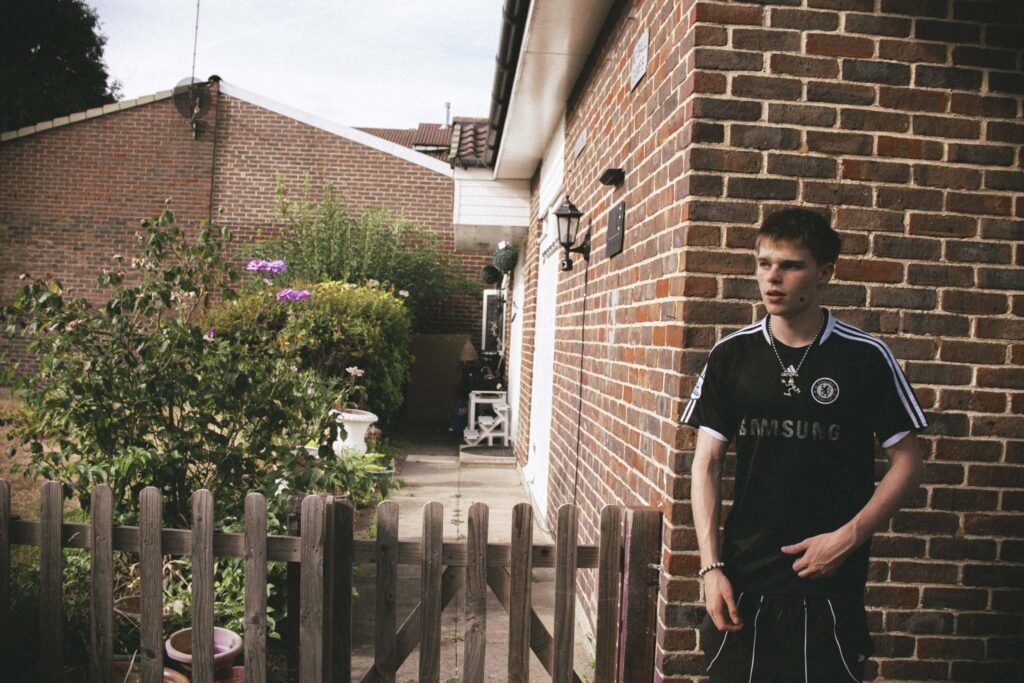
Ten minutes into our conversation, it was clear just how creatively eager Earf is and has always been. Long before he ever picked up a mic, Earfzilla began as a cover art page where he would draw the underground rappers he was listening to. What started as a side hustle selling album artwork quickly became his way into the scene. “I got a foot in the door,” he explains, eventually even creating cover art for Trippie Redd. For Earf, though, it was never really about the money or recognition. “It was really cool to just kind of be part of a scene and be part of a movement,” he says, describing a desire shared by artists, producers and fans alike: “Everyone wants to be part of something fun.”
From digital artwork, Earf moved into painting, using it to expand the world he was building around himself. “I don’t like sitting in a box or putting a label on myself,” he says, and his career so far seems to embody exactly that. His paintings brought him deeper into Dublin’s music scene, eventually leading to a gallery exhibition and connections with Irish rappers before he had even started making music himself. He later experimented with styling, even creating his own digital “pocket styling” packs (inspired by Pokémon cards!)
“I would basically make aesthetic styling packs, like Pokémon cards… I would split it into style, album art, advertising, different things, and accessories, and I would put it into a digital pack. People would buy them off me for advice and consultation.” Whether through art, fashion, styling or music, Earf has always found another way to create – and, more importantly, another way to build a world around himself.
E: I eventually kind of realized, like, if I’m doing all of this, I’m collecting all the Infinity Stones for other people’s gauntlets. I might as well just try to channel it all into myself. That’s when I started doing the music myself. That’s kind of how it all came about.
A: Was that the push for you to start making music? Like, you looking back at yourself doing all of these things for other people and then eventually wanting to try it out yourself.. or was there a specific moment where it was like, okay, maybe I should try making music myself.
E: It was, yeah. I don’t know if I’d say there was a specific moment, but there was just a chain of moments where I saw all these people and realizing I can really be young and build this whole creative world. But it wasn’t strictly music then, it was more like I could do the art.
Like, I’d see a rapper and I’d be like, “Man, if I was in his shoes, I would do this, this, or this.” Or I’d think about how I think the movement, the culture is going, and what my generation of kids would love to see.
I was always trying to direct stuff in my own head.
I don’t really care what people think of me. I’m just gonna make music that I think sounds cool, pair it with my image and my friends, and just build out this world. I’ll just see where it takes me. And then that’s just kind of what happened, to be honest, and it kind of went from there.
A: It’s so good to have so many different creative outlets, and it’s like you’re constantly running off of inspiration. It’s good to have a ton of inspiration from different things.
Do you feel like all of your different art forms, like painting, fashion, music, do you think they’re all connected, or do they feel like completely separate versions of you?
E: I am so strong with this belief that they’re all connected. It’s like different fingers on the same hand. It might not look like the same thing, but if you zoom out a little, you realize it’s all connected.
That was a big thing because I was going so crazy with the paintings, and it was my whole life, and then all of a sudden I started doing music. So many people, our friends and family, were like, “Man, I can’t believe you quit the painting.” And I’ll still hear that, like, once a week. “Oh, have you quit the painting? When are you gonna go back to painting?”
Not that people don’t like my music, but it’s just like people miss what isn’t there, I guess.
But my response all the time is just, it’s the exact same creative vision. Whether it’s a mic or a paintbrush, or if you write blogs or you dance or whatever you do, all that is in my head is just a tool of translation to execute the vision that’s in your head. You know what I mean?
It’s all the exact same kind of creative power. It’s just different tools used to get out into the physical world so other people can see it and kind of get to know what’s going on inside your head. I can think about how I want my songs and music videos to be like, I creatively direct my music videos because I’m just so picky on stuff. I edit all my TikToks and the graphics. All the cover art, I do it all myself because I’m so picky on it.
But that was a big thing starting the music. I knew I wanted it to look a certain way visually, and I had to make so much music to kind of get the sonics of it to match up with how I think visually.
A: I was about to ask, because you again, do so much of this creative stuff and you literally creative direct your own career, do you feel like you’re building the project as you go, or do you already have this whole world imagined?
E: I definitely had the whole idea and the world written down. Had the name written down, had the idea and the aesthetic and the mood boards all written down, like, four months ago, before I’d only just dropped my first song.
Over the past couple months, I’ve been experimenting, making loads of music, meeting people, living my life, and trying to figure out the sonics of it. I think I’m the opposite to a lot of artists, I have everything visually locked in my head and then I have to go and catch up sonically.
I think another thing with the world of Earfzilla is that I put so much thought into it, but at the same time, it’s never really needed because there was no kind of scheme for Earfzilla. Because obviously, at the end of the day, I still have to go to school, and I still go to the corner shops, I’m still talking to my mates, I’m going to parties and stuff.
This was just an account where I posted myself and my art.
Behind Earfzilla is still just an 18-year-old finishing secondary school, trying to figure out homework and a music career at the exact same time. His rise happened so quickly that there was barely any time to process it, hitting right in the middle of the school year. “I just completely shot up when I dropped my first song,” he tells me, recalling how he’d find himself hiding out in school bathrooms, skipping class to figure out how DistroKid worked and trying to get the next track out. By his own admission, he isn’t someone who gets easily swept up in the hype–he sets the bar remarkably high for himself and stays hyper-critical of his own output. But even for someone who keeps his expectations tucked away, the moments where reality catches up with the numbers are impossible to ignore.
After spending plenty of time as a supporting act, everything clicked into place when he stepped up for a sold-out headline show at Catacombs (the holy grail for Irish underground music) that just happened to land right on his 18th birthday. Used to playing the opener whose job is just to warm up a room, stepping into the “final boss” slot to headline a packed, 220-cap venue felt completely surreal. He had written these tracks in his nan’s living room, his bedroom, and with his mates, and suddenly he was looking out at a room full of peers shouting every single word back at him.
“You look at all these people that were literally my age, some of them older, and it’s just like, ‘I don’t even know how this happens,’” he reflects.
The night spun into full rock-star territory, complete with a fan crowd-surfing onto the stage and Earf getting swarmed outside after the show to sign shoes, vapes, and tees. Hilariously, some of these people were even coming up to his own friends (completely unaware that they were, in fact, his own mates) asking them to hand over their phones so Earf could sign them.
When I asked how his friends felt about all of this, he tells me that, while his family knew he was always doing something creatively, they had no idea he was making music until he essentially had to tell them. Even then, his parents apparently weren’t all that surprised. “They were like, ‘He’s always doing some stuff.’” His inner circle, however, views the whole shift with a healthy dose of humor. For his closest mates, watching him step into the spotlight is equal parts bizarre and hilarious. To them, he’s still the same guy they went camping with the night before, who turns up to school and makes the same foolish mistakes as anyone else so watching fans swarm him in town for photos only gives them endless material to tease him with. “They just find it really funny because they’ve seen me at my worst, and they’ve seen me at my best… They just make fun of me, being like, ‘Man, if only these people knew how stupid this guy is,'” he laughs. Yet behind the lighthearted banter, there’s a real sense of shared growth as everyone around him figures out adulthood simultaneously. As he puts it, “It’s almost like all my mates are navigating it with me, and my family as well. We’re all just kind of navigating it together.”
A: With the rate that you’re climbing… maybe you won’t be a secret for too long anymore. Do you like that title, or are you trying to escape being a secret?
E: The origin of that, I had “best kept secret” in my bio since I was 16. It’s like a slogan that I live by. It was from the paintings because I felt like I was doing a whole lot.
I feel like this is the thing with the internet and with people in general, and also young people. Everybody’s trying to be the next billionaire, the next rapper, businessman. I feel like everybody does so much talking, myself included. Everyone does so much talking that you end up getting nothing done.
And I was kind of sitting in my room because I used to just paint my room all day. I just bought a new canvas and I shaved my head. I was like, “This is a real new chapter.” I was like, I’m going to just not tell anybody anything I’m doing until it’s done. And when it’s done, I can talk about it as much as I want. I can put it out into the world, and I can let the thing, the painting, do the talking.
The idea became something of a personal rule for Earfzilla. Rather than announcing every big plan before it happened, he wanted to let the work speak first. “If I just shut up and got to work, I would have so much stuff under my belt,” he says. He started stamping “Best Kept Secret”, or BKS, onto his paintings and keeping it in his bio as a reminder to himself to stay quiet and get on with it.
“The whole Best Kept Secret thing came from me trying to promise myself that I would just stay silent and get to work because I’m a very talkative person.”
Then somebody took the phrase and put “Dublin” in front of it. He can’t even remember whether it was a comment or a DM, but he remembers seeing it and immediately thinking it made strange but perfect sense. It gave the phrase another layer. The city where he’s from is also the place that shaped his eye, his community and the roots of the world he’s building.
To whoever wrote that comment or DM, shoutout to you.
I learned that there’s actually a whole philosophy behind the name Earfzilla. It started when he was heading into secondary school and met an art teacher–a graffiti artist from Dublin whom he still keeps in touch with–who ran an art club every Friday at lunchtime. For him, that art club was quite literally the reason he would turn up to school. He mostly wanted to impress his teacher and earn his respect. So he bought a new sketchbook, made an Instagram account for his drawings, and gave himself the name The Random Earthling.
The name came from something he had been big about for a while, the idea of being an “earthling” in the most literal sense. “If you were to really zoom out past all of that kind of structural way of thinking, we’re just dots on a big rock,” he explains. Strip away nationality, where you live, the football team you support, where your parents are from and all the things we use to define ourselves, we’re all just people on the same planet.
He liked that idea of taking all those structures away and simply being an earthling. “I think people should think about how cool that is, that we’re all just kind of the same thing, even though we’re so different.”
There was just one problem. The Random Earthling sounded rubbish. So he kept the “Earth” and started looking for something with a little more bite. ..Borrowed from the takeover energy of Godzilla, the suffix turned something universal into something monstrous, almost mythical. Earth was the idea that we’re all the same; Zilla was the idea that, because we’re all the same, there’s no reason any one person should be able to do something that another can’t. “With the logic that we’re all the same, we can all take over and do whatever we want,” he says. “Because if we’re all the same, how can he or she do it, and I can’t?” Of course, there’s one final ingredient to the name, “It does have to sound cool.”
That same love of strange, expansive worlds runs through pretty much everything Earfzilla does. Growing up, he was obsessed with cartoons and the freedom of worlds like Adventure Time, Steven Universe, Regular Show, as well as free-roam video games where you could simply wander around and exist. What he loves most is that these worlds don’t always need to mean something.
“I just love building huge worlds that don’t need to be important,” he says. Even his music follows that same instinct, to build somewhere people can step into, without demanding that they find some grand meaning waiting for them. “I’m a big nerd about world-building,” he tells me. “I like when you can build such a detailed, thought-out world, and it matters to nobody. I think it’s so cool.” And if someone happens to wander in and enjoy it, like a listener walking into a song or someone entering an art gallery, even better.
A: Do you think of yourself as a musician first now, or just a creative person who happens to make music?
E: I just kind of view myself as a human. I know that sounds so corny, but it’s really just like, I view all the music as a tool of expression.
However you know me, what you know me as.. I have all this creative stuff going on in my head, and it’s just output. It’s all just output, the music, the art. I never really think of myself as a musician or a rapper or an artist or a painter.
I just view myself as, I suppose, a person with imagination. I think everybody obviously is in their own respect, but I still kind of find it weird to tell people that I’m like a rapper or a music artist. I didn’t even get comfortable telling people I was a painter.
I just tell people I make paintings or I make music, and that’s what I do.
Because it’s just a person with an attachment or an output, if that makes sense. I find it so weird to just call myself a title because I never feel like I fully fit into it. And that could also be a confidence thing, but I don’t know. I view everybody in this sense that we’re people that do things.
A: What are you most excited for next?
E: I’m most excited to get this project out.
I’m excited to really show people for the first time all the stuff that’s going on in my head. Because you can only say so much with five songs, and I’m really excited to put together a body of work. I’m so happy to just put together a cohesive body with a world to it, with me creatively directing all of it, and having my friends along the way help with it.
It’s a very small team working on it in terms of producers and features and all that kind of stuff. I’m just really excited to be able to put something out that I’m so proud of and be like, “Yeah, this is what I’m about,” and then I suppose I’ll see where it goes from there.
A: Will the project be released soon?
E: Yes. I believe in when the time is right type of thinking. If you see my Instagram, you’ll see I’ll be saying, “When the leaves turn brown,” and I’m just going to stick by it. When the leaves turn brown, that’s when it’s going to happen.
The internet gets a lot of shit, and obviously for plenty of valid reasons, but people far too easily overlook how incredible it is at actually building community. Chatting with Earfzilla was a genuine reminder of how amazing it is to see so many young people our age fully tapping into their passions, putting in the work, and putting themselves out there. At the end of the day, there is nothing more human than creating–and having a global canvas to share it on changes everything.
“I think it’s just great to see what the Internet can really do,” he reflects. “I know for a fact I wouldn’t be doing any of this without the Internet. The whole idea of the Internet generation… I just love the hybrid of what’s going on nowadays between being an Internet kid, being from the Internet generation, and bringing your real life into it. It’s so cool to see.” That blend of online culture and raw, real-world connection is where his story thrives–a kid who used to scour curated playlists for inspiration at 12 or 13, now actively shaping the very culture he grew up studying.
By the end of our conversation, I think what struck me most was just how incredibly excited Earf is to create. You can hear it when he talks, he’ll jump from music to painting to cartoons to Dublin to his own philosophies and make it all feel like part of the same conversation. It’s not really about being a rapper, or a painter, or a creative director to him but more about having all these things in his head and finding different ways to get them out into the world.
There’s something especially exciting about watching someone who is still figuring themselves out while already having such a clear sense of the world they want to build. Earfzilla is a human trying to turn everything in his head–music, painting, fashion, internet culture, Dublin, childhood, imagination–into one cohesive world. I absolutely can’t wait to see what he builds next. More importantly, what kind of world we’re all about to get invited into.
So, Earf, we’ll be waiting!